What a French Press Is—and How It Differs from Pour-Over
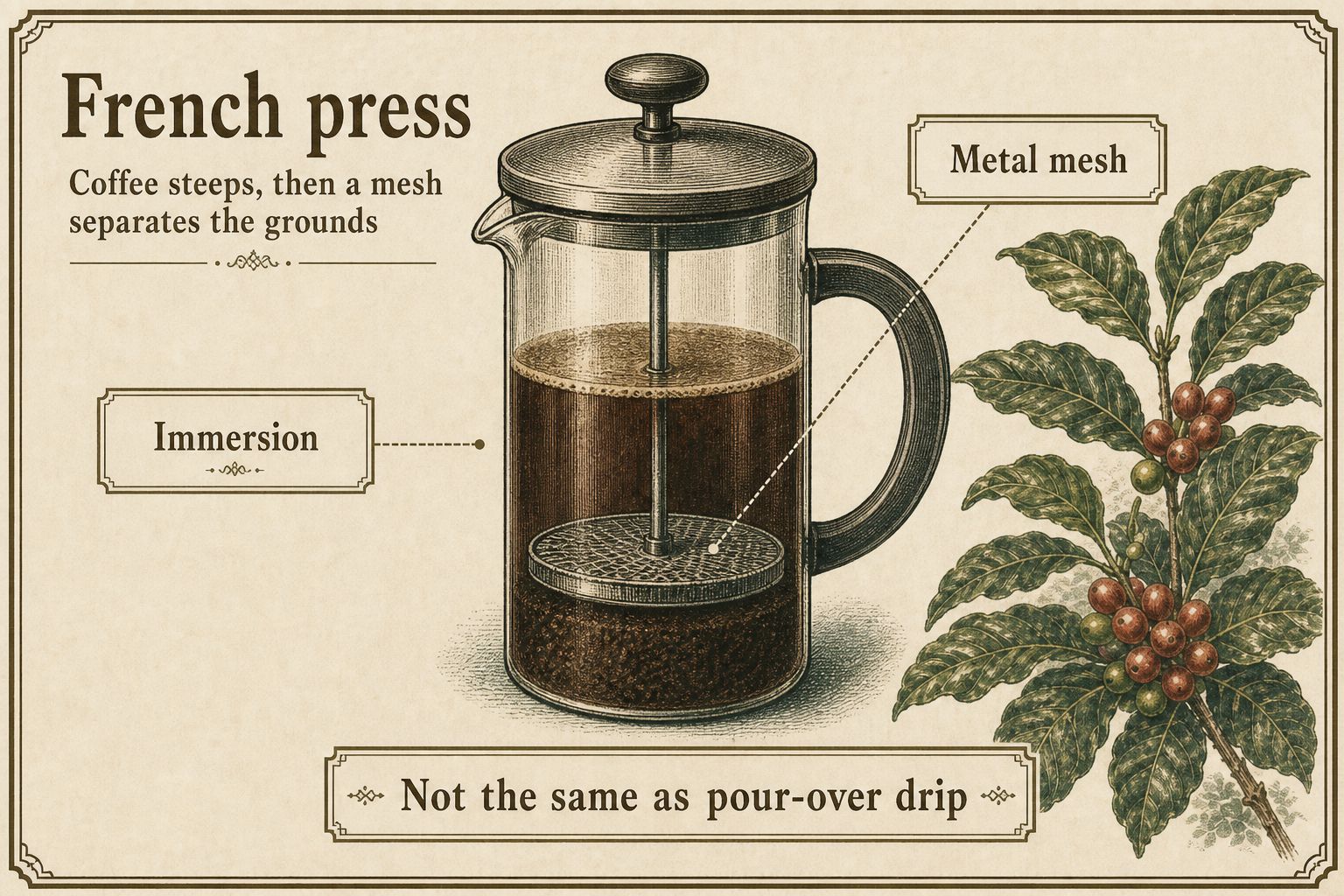
A French press steeps ground coffee in hot water before a metal-filter plunger separates the grounds from the drink. Unlike pour-over, where water keeps flowing through the coffee bed, it uses immersion. The filter allows more oils and fine particles through, often producing a fuller body and sometimes a gritty texture.
Updated: Sep 7, 2026Reviewed by: Content and layout review
What a French press is
A French press steeps ground coffee in a cylindrical vessel of hot water. A plunger fitted with a metal filter then pushes the grounds to the bottom so you can pour off the coffee. You may also see this type of brewer called a cafetière or press pot.
You can use the same beans for a French press or pour-over. The main differences are how water contacts the grounds and which filter separates them from the finished drink.
The shape is older than the English name. The New York Times notes that William Ukers’s 1922 All About Coffee never described this plunger pot. In March 1852 a Paris patent covered filtering coffee by a piston: tin pierced with holes, sandwiched between layers of flannel, pressed into a cylinder, with clear coffee above it. Later designs used a tighter mesh against the wall. U.S. Patent 1,797,672, granted in 1931 to Ugo Paolini and assigned in part to Attilio Calimani and Giulio Moneta, is one of those infusion pots: a sliding filter traps the grounds while the liquid pours off.
How it differs from pour-over
Pour-over relies on gravity to carry hot water through a bed of coffee and a paper filter. This is percolation, where water extracts material as it passes through the grounds. A French press uses immersion, keeping the grounds in the same volume of water during the steep.
Scott Rao also compares how concentration changes during brewing. An immersion slurry grows more concentrated as it approaches saturation, while incoming water dilutes a percolation slurry. After you pour coffee from a French press, the liquid retained by the grounds is close in strength to the coffee you poured out.
The filter also affects the result. Paper holds back more oil and often produces a cleaner-tasting drink, while metal mesh allows more oils and fine particles through. French-press coffee therefore often feels fuller in the mouth, sometimes with a gritty texture.
Brewing-method illustration: pour-over on the left sends water through the coffee bed, while the French press on the right keeps the grounds steeping in the vessel.
A simple home sequence
To brew with a French press at home, follow this basic sequence:
Put a coarse grind in the carafe.
Add hot water and wet all of the grounds.
Let it steep.
Press the mesh down slowly.
Pour into a cup or another vessel. Coffee left sitting on the grounds keeps extracting.
Published starting points vary. Perfect Daily Grind’s 2015 guide suggests about three to five minutes and a ratio near 1:15, while a 2020 interview proposes trying two to six minutes. These references can be adjusted to the coffee and the result. SCAA Golden Cup separately lists six to eight minutes of contact for coarse-ground filter brewing; that range should not be treated as a fixed requirement for French press.
For coffee and water amounts, see brew ratio; for particle size, see grind size. Perfect Daily Grind notes that a plunger that is difficult to press often indicates an overly fine grind.
Filter comparison: paper holds back more oil, while metal mesh allows more oils and fine particles through. A fuller texture does not necessarily mean a more concentrated drink.
What the cup often feels like
French-press coffee often feels heavier in the mouth because the metal filter allows oils and fine particles to remain in the drink. This fuller body differs from strength, which is more directly affected by brew ratio. A paper-filtered pour-over often tastes cleaner and feels lighter.
Perfect Daily Grind notes that people who dislike a gritty texture may prefer another method. When many fine particles pass through the filter, they can give the drink a sandy feel.
A French press uses immersion and a metal filter, while grind size, brew ratio, and contact time still affect extraction and flavor. For more on extraction speed, bitterness, or a lack of flavor, see over-extraction and under-extraction.
Common Misconceptions
Is a French press a kind of coffee bean?
A French press is a brewing method: coffee grounds steep in hot water before a metal filter separates them from the liquid. You can use the same beans for pour-over, but adjust the grind for each method.
How is it different from pour-over?
Pour-over sends hot water through a bed of coffee and a paper filter, while a French press steeps the grounds in hot water before separating them with a metal filter. Paper holds back more oil; metal mesh allows more oil and fine particles into the drink.
Does the grind have to be coarse?
A coarse grind is a common starting point because the grounds steep for longer and metal mesh allows fine particles through. Perfect Daily Grind notes that grinding too fine can make the plunger difficult to press and leave a gritty texture. For more on how particle size affects extraction, see the guide to grind size.
Is sediment in the cup normal?
Some sediment is expected because fine particles can pass through the metal filter. A pronounced sandy texture usually comes from grinding too fine or plunging hard enough to stir those particles into the brew.
Is this the same as espresso?
No. Espresso forces hot water through a fine bed under pressure and makes a small cup with crema. A French press does not use that pressure, and the serving is usually much larger.
Is French-press coffee always stronger?
Not necessarily. Brew ratio has a more direct influence on strength, while the heavier texture often comes from oils and fine particles in the drink. That fuller body does not by itself mean the coffee is more concentrated.
Scott Rao, Immersion vs. Percolation: Have We Been Calculating Extraction Incorrectly?, 2017: Compares concentration during immersion and percolation. An immersion slurry approaches saturation, while fresh water moving through a percolation bed lowers slurry concentration. Liquid retained by French-press grounds is close in strength to the poured coffee. The brewing-method comparison is cited here; the disputed extraction calculations later in the article are not adopted.
Fabiola Solano, French Press – The History & Brewing Guide, Perfect Daily Grind, 2015: Describes full immersion with a metal filter and the fuller body that can result from retained oils and fine particles. The guide warns that an overly fine grind can make the plunger difficult to press and increase sediment or grit. It suggests three to five minutes and about 1:15 as home starting points, rather than fixed requirements. Pouring the coffee into a cup or another vessel separates it from grounds that would otherwise keep extracting.
Ana Paula Rosas, Green Home Brewing: Four Ways To Make Paperless Coffee, Perfect Daily Grind, 2020: Compares paperless brewing with paper filtration. The article describes paper retaining lipids, some acids, and astringent polyphenols, often producing a cleaner taste and lighter body; metal mesh allows more of these substances through. French press generally uses a longer steep and coarser grind than pour-over. Interviewee Lucci suggests trying two to six minutes. The amounts discussed are individual examples, not a universal recipe.
SCAA Standard, Golden Cup, revised 23 December 2015: The 2015 filter-brewing reference gives 55 g of coffee per liter of water, plus or minus 10%, and a contact temperature of about 93°C, plus or minus 3°C. Contact-time ranges are 1–4 minutes for fine, 4–6 for drip, and 6–8 for coarse. These filter-brewing references should not be treated as fixed French-press steeping times.
Daniel Engber, Who Made That French Press?, The New York Times Magazine, 2014: Traces the history of plunger-style brewers. Ukers's 1922 All About Coffee did not describe this device, although a March 1852 Paris patent used perforated tin between layers of flannel as a piston filter, leaving filtered coffee above it. Later Milanese designs improved the seal. Cafetière remains a common British name. The historical account relies on traceable records rather than unsupported invention stories.
Ugo Paolini, Apparatus for preparing infusions, particularly for preparing coffee, U.S. Patent 1,797,672, 1931: Documents a U.S. patent filed in 1929 and granted in 1931 for a vessel with a sliding filter that retains grounds at the bottom while liquid passes through. Paolini is named as inventor, with half interests assigned to Calimani and Moneta. The record establishes an early example of this brewer design, rather than proving that a modern brand invented French press.