Brewing temperature mostly changes how fast extraction runs. Hotter water usually dissolves soluble material faster. The SCAA Golden Cup puts water at contact around 93°C, plus or minus 3°C. The number on the kettle is often not the temperature of the slurry in the brewer.
Updated: Aug 27, 2026Reviewed by: Content and layout review
What the water is changing
Extraction is the process of water dissolving and drawing soluble material out of coffee grounds. Higher water temperatures usually increase molecular motion and help those compounds dissolve faster, while cooler water generally slows the process.
Temperature is one brewing variable, alongside grind size and contact time. When you want to change how a coffee tastes, temperature is one place to start. Change one thing at a time to identify whether temperature, grind, or contact time changed the flavor.
The diagram contrasts faster extraction with hotter water on the left and slower extraction with cooler water on the right. It does not represent a specific kettle.
Boiling water does not change how far the roast already developed. The beans already saw temperatures far above a kettle. In a WIRED interview, James Hoffmann puts it this way: if you think boiling water burned the coffee, those flavors were already in the bean; hot water only extracted them.
Contact temperature is not the number on the kettle
The SCAA Golden Cup describes filter coffee with water at the point of contact around 93.0°C, plus or minus 3°C. That is a recommended window when water meets the grounds, but it is not a spec plate on a kettle, and it is not a setting every coffee should use.
SCA’s later home-brewer standard (SCA 310-2021) measures something else: slurry temperature. For certification, the mix of grounds and water should reach 90°C to 96°C by the time the brew has reached about one third of the water volume, and stay in that window.
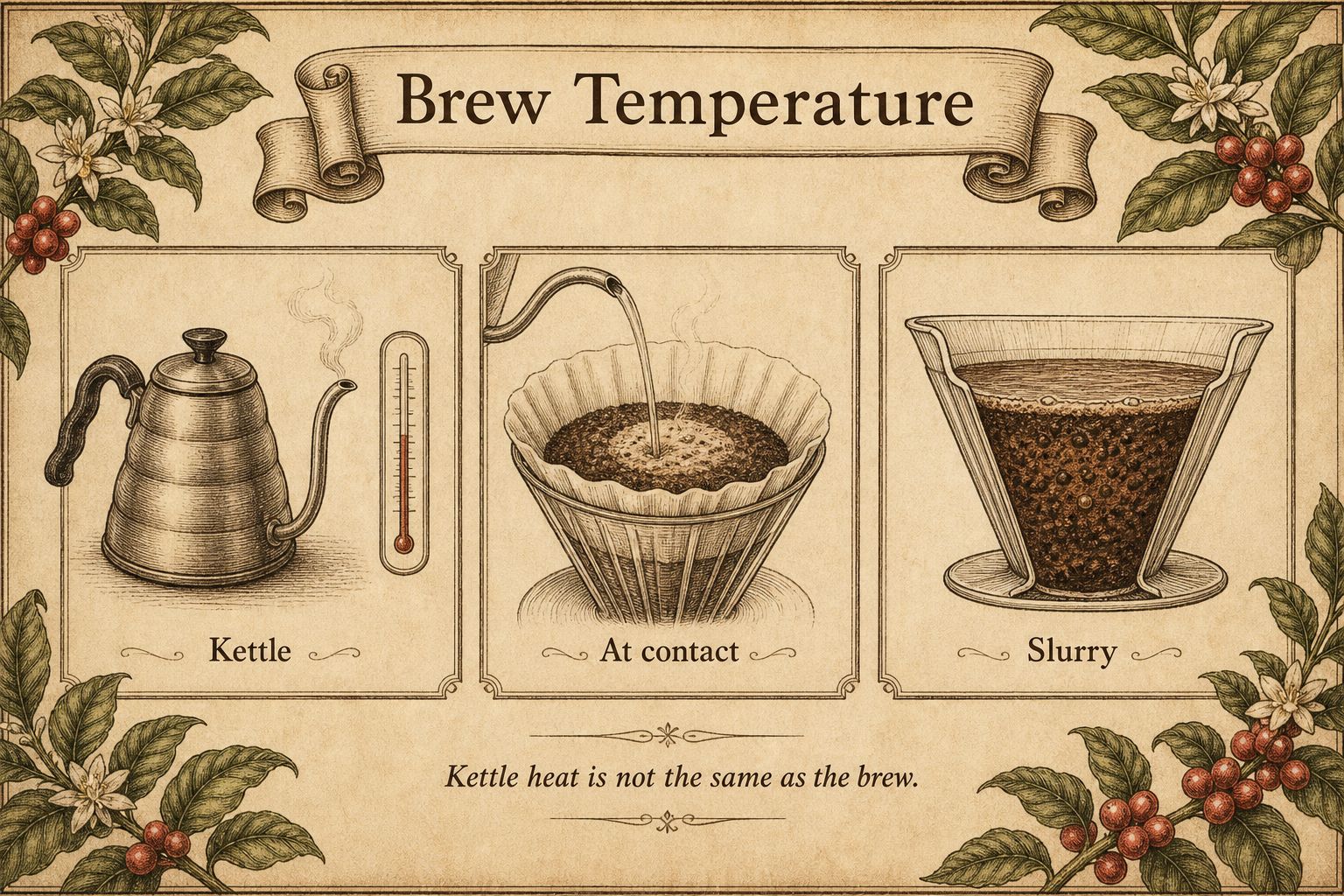
During pour-over, hot water loses heat to the room-temperature grounds, the cooler brewer, and the surrounding air. Barista Hustle explains that slurry temperature—the temperature of the grounds and water inside the dripper—is often more relevant to pour-over extraction than kettle temperature. The mixture is usually cooler than the water in the kettle. The same page cites Colin Runnion’s measurements: kettle water near 96°C, slurry never reaching 90°C in that brew.
The diagram shows water in the kettle on the left and the coffee-water mixture after pouring on the right. Heat is lost to the coffee, the brewer, and the air. The drawing is a diagram.
Rinsing the paper and warming the cone is also a way to keep the brewer from stealing as much heat. Ceramic drippers commonly need that preheat; plastic does not absorb heat as readily. Pour-over starter equipment already notes that materials differ in how they hold heat, while filter shape still has to match the brewer first.
Compare extraction before choosing a temperature
People often treat a fixed brew temperature as a guarantee that the coffee will taste good. In 2020 the UC Davis Coffee Center drip-brewed the same coffee at 87°C, 90°C, and 93°C, then changed grind and brew time so brew strength (TDS) and extraction yield landed in the same places. After the trained panel tasted the coffees, differences in brew strength and extraction yield were still the main thing they noticed. Even at different water temperatures, adjusting the rest of the brew still changed the extracted flavor.
SCA’s 25 Magazine later put the practical reading this way: at least between 87°C and 93°C, if you can arrive at a similar extraction, the sensory profile and consumer liking do not split on brew temperature itself.
That does not make temperature irrelevant. The same research still treats hotter water as a faster extractor. If you change only the water temperature, the resulting extraction can also change, affecting whether the coffee shows signs of over-extraction or under-extraction. In the experiment, researchers first matched extraction results; under those conditions, temperature itself had little sensory impact.
So when you change only the water temperature at home, and keep the rest of the method the same, flavor differences are easier to taste. A sharp, thin cup that never sweetens is a common under-extraction pattern. A dry, harsh, bitter finish is a common over-extraction pattern. Water temperature, grind size, and contact time are all variables you can adjust. See grind size and pour-over.
Adjust for roast level and taste the result
In a Perfect Daily Grind interview, a roaster sets a working hot-water window of 90°C to 96°C. Darker roasts often extract more readily, so a lower water temperature can help avoid excessive extraction. That is a tendency, not a rule that light roasts must see a rolling boil and dark roasts must sit at one fixed cooler number.
The coffee’s fruit acidity and bitterness from roast are difficult to change substantially through water temperature alone. For acidity that is about the coffee, not the brew, see why coffee tastes fruity.
You do not have to buy a temperature kettle first
A variable-temperature kettle makes the same kettle setting easier to repeat. It does not keep slurry temperature constant, and it does not guarantee a better cup.
Pour-over starter equipment already says you can aim at the Golden Cup contact window without buying a temperature-controlled gooseneck. An electric kettle plus a thermometer, or a short rest off the boil, is a common workaround. Get a pour you can repeat, then decide whether temperature control is the next tool.
Common Misconceptions
Does boiling water burn coffee?
Boiling water does not change how far the roast already developed. Roasting already ran much hotter than boiling water. A harsh cup is more often flavors that were already in the coffee, or contact that ran too long.
Do I have to brew at 93°C?
No. Golden Cup describes about 93°C at contact, plus or minus 3°C. In drip tests between 87°C and 93°C, matched extraction left little sensory difference. That is not a setting every coffee should use.
Do light roasts always need hotter water?
Not as a rule. Darker roasts often extract more readily, so a cooler kettle sometimes keeps extraction from running away. That is a tendency. Change one variable and taste the bag in front of you.
What if I do not have a variable-temperature kettle?
You do not have to buy one first. A kettle plus a thermometer, or a short rest off the boil, is a common workaround. A variable-temperature kettle makes the same kettle setting easier to repeat. It does not lock slurry temperature, and it does not guarantee a better cup.
Is cold brew less bitter because the water is cooler?
Cold brew uses room temperature or fridge-cold water and a long steep. That is not the same as brewing hot and pouring over ice. Temperature alone therefore does not explain the difference between the two methods.
Is espresso the same temperature?
Espresso water is set by the machine and uses a different working range. Do not copy a filter contact number onto a group head. Details belong on the espresso page.
SCAA Standard, Golden Cup, revised 23 December 2015: Third-party copy of the SCAA Golden Cup sheet. Filter coffee is described with water at the point of contact at 93.0°C ± 3°C. An industry reference of the time, not a kettle spec and not a setting every coffee should use.
Andrew Cotter, How Hot is Hot Enough?, SCA 25 Magazine, Issue 15: Industry write-up of the same UC Davis work. Hotter water usually extracts faster; within 87°C to 93°C, matched extraction left little sensory or liking difference from temperature itself. The article also compares cold brew with hot coffee chilled over ice to discuss a larger temperature difference.
Tasmin Grant, How can you make water perfect for brewing coffee?, Perfect Daily Grind, 2022: Jennifer Yeatts of Higher Grounds describes a working water-temperature range of 90°C to 96°C. Darker roasts often extract more readily, so slightly cooler water can help avoid excessive extraction. The article is sponsored; these brewing observations are cited without endorsing its brands or water products.
Barista Hustle, The Ideal Temperature for French Press, 2020: The useful number in pour-over is often slurry temperature—the mix of grounds and water—not kettle temperature. Slurry is usually well below the kettle. The page cites Colin Runnion’s measurements: kettle water near 96°C, slurry never reaching 90°C in that brew. French-press advice is not copied as a recipe here.