What Is a Clever Dripper—and How Is It Different From Pour-Over?
A Clever Dripper looks like a pour-over cone, but it steeps the grounds first, then drains through paper when you set it on a cup. Unlike pour-over, water does not keep moving through the bed the whole time. Unlike a French press, paper holds back more fines and oil.
Updated: Sep 7, 2026Reviewed by: Content and layout review
A familiar shape with a steep-and-release valve
In a cafe, a Clever Dripper looks at first like an ordinary pour-over cone. The real difference is a shut-off valve in the base: on the counter, water and grounds can sit together; on a mug or carafe, the valve opens and the brew drains through paper.
You can use the same coffee in a Clever Dripper or for pour-over, adjusting the grind to suit each method.
The maker is E.K. International in Taiwan. The company calls the method Direct Immersion Brewing Method. The same bottom shut-off appears on HandyBrew: the Clever adds a paper filter for a cleaner cup, while HandyBrew uses built-in screens.
HARIO’s Immersion Dripper SWITCH also steeps the grounds in hot water before filtering, but it uses a switch to release the coffee and takes V60 paper filters. It follows a similar principle to the Clever Dripper, with a different release mechanism and filter shape.
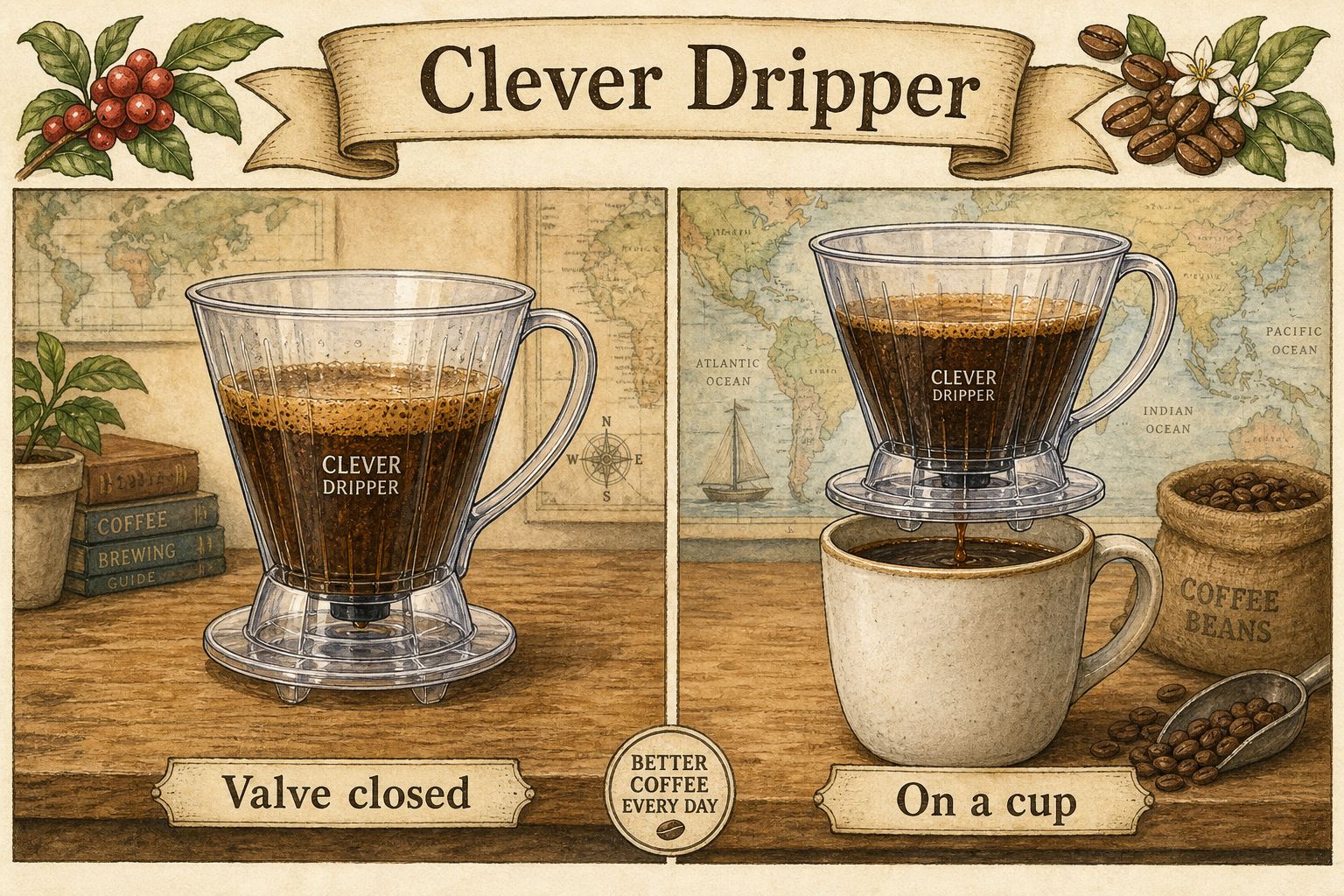
When the water is in and the Clever Dripper sits on the table, the valve stays closed and the liquid cannot leave. The grounds steep in the water, much as they do in a French press, instead of water continuously passing through the bed.
Set the brewer on a cup or server and the rim presses the stopper. The valve opens and the brew falls through paper by gravity. Lift it off and the valve closes again. James Hoffmann describes this class of brewer as steep-and-release: when you are ready, you set it on a cup or carafe, the stopper lifts, and the liquid drains.
The valve lets you choose how long the grounds steep before filtration starts, without relying on the speed of a circular pour to control that steeping time.
The left side shows the grounds steeping with the valve closed; the right shows coffee draining after the brewer is placed on a cup. This is a mechanism diagram, not a product photo.
Bump the base during the steep and the valve can open early. That is the mechanism working as designed, not a separate switch.
Pour-over, press, and this hybrid
Pour-over is pouring hot water into a dripper so the water keeps moving through the grounds and paper. Scott Rao calls water moving through a bed percolation, as opposed to grounds sitting in the water. Perfect Daily Grind describes that continuous path through the bed as the usual filter-drip pattern.
A Clever Dripper first steeps the grounds in water, then lets the brewed coffee drain through paper by gravity, combining immersion with a final filtration stage.
A French press also steeps, then uses a mesh screen. More fines stay in the cup, and the texture is often thicker. Paper in a Clever Dripper holds back much of the oil and sediment, so the cup is often cleaner. These are common tendencies; the coffee itself also affects texture, so a Clever Dripper does not always produce a thicker or thinner drink than pour-over.
From left to right, the diagram compares pour-over, Clever Dripper, and French press. All three can brew the same coffee, but they differ in water contact and filtration.
A 2019 review by Scott Fisher, hosted in translation on the manufacturer’s site, notes that the cone resembles a Melitta dripper and that you can also leave the valve open and use it as an ordinary drip cone. In that mode, pour and grind matter more, the way they do in pour-over.
The paper still has to fit
Use a filter that matches the cone. Melitta-style trapezoid papers are the usual fit; the large size often takes #4. Hoffmann uses that #4 shape for the larger brewer and not a V60 cone.
A poorly fitting filter can wrinkle or leave gaps that allow water to bypass the coffee bed. Filter thickness also affects water flow. Color, bleaching, and rinsing are covered on bleached vs. unbleached filters. After rinsing, set the brewer on a cup so the valve opens and the rinse water can drain.
So a Clever Dripper can be understood as steep first, then filter into a cup. It does not guarantee a better cup, and it does not replace pour-over, but it is relatively stable: fewer pouring variables, and simpler to run. A gooseneck kettle is not required, but the filter still needs to fit the brewer, and grind and water temperature should suit the coffee.
Common Misconceptions
Doesn't HARIO make a Clever Dripper too?
HARIO makes the Immersion Dripper SWITCH. It also steeps, then releases, but you press a switch, and it uses V60 paper. A Clever Dripper opens when it sits on a cup and usually takes trapezoid papers.
Is it the same method as pour-over?
No. Pour-over keeps water moving through the bed. A Clever Dripper steeps first, then drains when you set it on a cup. It looks like a cone and behaves more like immersion plus paper filtration.
Does it always taste better than pour-over?
No. Paper holds back fines and much of the oil, so the cup is often cleaner. Flavor still depends on the coffee, grind, and water.
Do I need a gooseneck kettle?
Not for the steep-first method, where the main aim is to wet the grounds evenly. Pouring control matters more if you leave the valve open and use it as a regular pour-over dripper.
Can I use V60 filters?
Usually no. The cone commonly takes Melitta-style trapezoid papers; the large size often uses
How is it different from a French press?
Both steep coffee grounds, but a [French press](/en/basics/french-press/) uses a metal mesh screen that allows more fines into the drink. A Clever Dripper uses a paper filter, which often produces a cleaner texture.
EK Int’l Co., Ltd., HandyBrew: Manufacturer description of a patented bottom shut-off system. The Clever uses an extra paper filter for a cleaner cup; HandyBrew uses built-in filters.
HARIO, Immersion Dripper SWITCH: HARIO's immersion dripper steeps the grounds, then starts dripping when a switch is pressed. It ships with V60 paper, not the trapezoid papers common on a Clever Dripper.