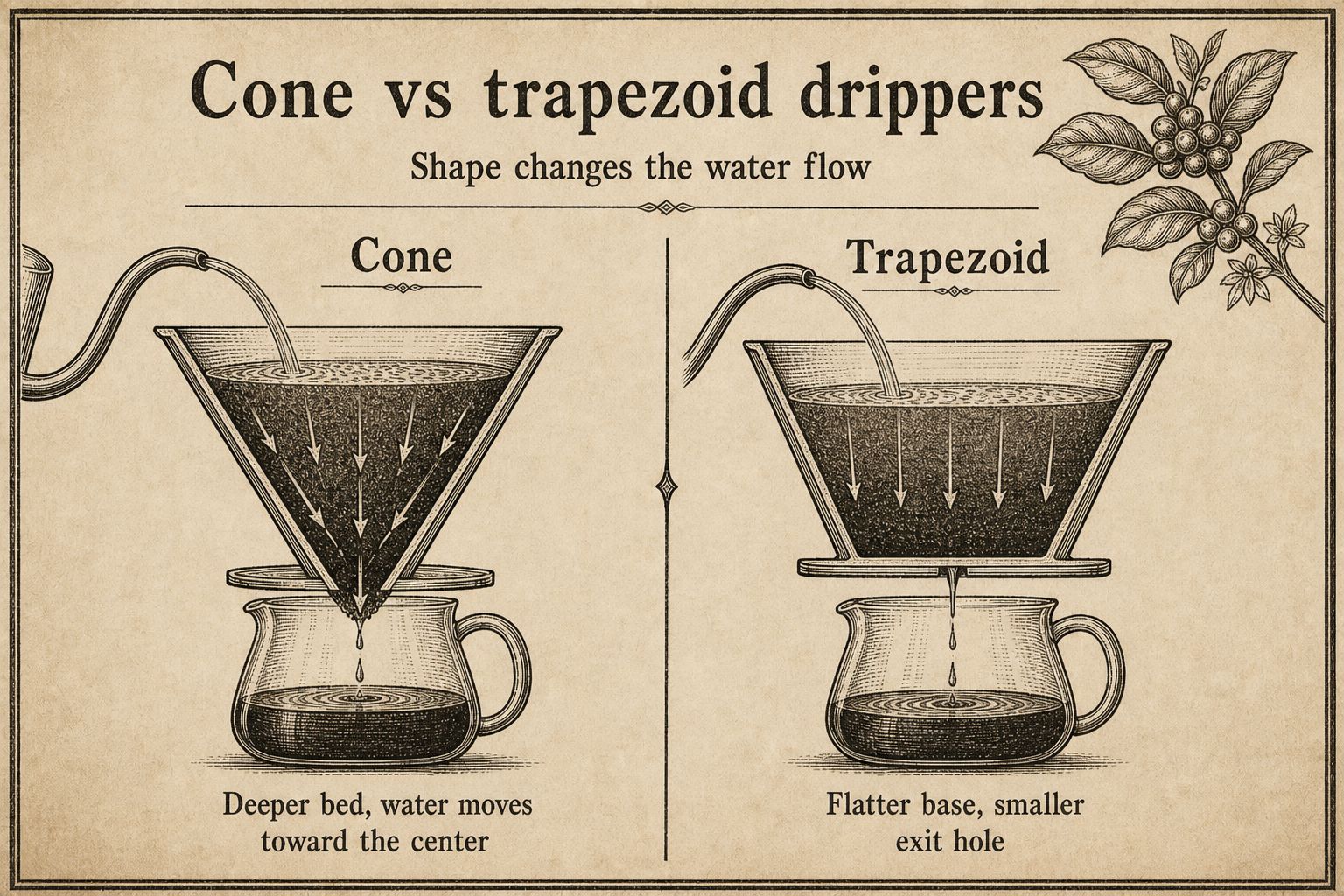
A cone dripper holds a deeper, pointed bed and sends water toward the center. A trapezoid or wedge dripper, the Melitta-style shape, has a flatter base and usually a smaller hole, so flow is relatively slower. Both are gravity drip methods. A Kalita Wave is a different dripper: flat-bottom, with wave paper.
Updated: Sep 3, 2026Reviewed by: Content and layout review
The difference is the shape
Cone and trapezoid drippers differ in how they hold the paper and how water moves through the bed. Both are pour-over methods that filter coffee by gravity.
A trapezoid dripper is the Melitta-style wedge: a flatter, narrower base and matching wedge paper. HARIO calls the older common shape fan-shaped, and uses it to contrast the V60: the V60 is a sharper cone, not a fan. Kalita’s 102 and 103 sit in that trapezoid or fan family. Their Wave is a flat-bottom dripper with wave paper, not the same dripper.
This comparison covers cone and trapezoid or wedge drippers. The Kalita Wave belongs to a separate flat-bottom design that uses wave-shaped filters.
HARIO describes the V60 as a 60-degree cone. The company says the bed is deeper than in conventional fan-shaped drippers, with water moving toward the center. One large hole means flow depends mainly on how fast you pour, and on the rib structure. The ribs are ridges on the wall, so the paper does not seal flat against it; gas can leave during the bloom, and the bed can swell.
Trapezoid drippers usually have a smaller hole, so water tends to linger at the base and flow is relatively slower. Kalita describes the 102 and 103 as a straight-sided cone style with three-hole extraction and a slightly longer process. Many Melitta home cones use one hole. Similar drippers can have a different number of holes and still share the same shape family, but you may need to tweak how you brew.
Perfect Daily Grind also records that dripper shape changes how fast water moves through the bed and how much it agitates the grounds. The same coffee and grind can cup differently after you change the brewer. In the cup, a cone is not guaranteed brighter, and a trapezoid is not guaranteed fuller; pour, water temperature, and grind also change flavor. Still, when other conditions were held the same, a drip-machine experiment found that a more conical versus a flatter basket also changed strength and sensory results. Those were machine conditions, not a home pour-over recipe.
The cone dripper on the left and the trapezoid dripper on the right both use gravity to draw water through the grounds and filter. This is a structural illustration, not a product photo.
Match the paper to the dripper
Cone drippers take pointed cone papers, commonly HARIO V60 01 or 02. Trapezoid drippers take wedge papers, commonly Melitta #2 or #4, or Kalita 101 and 102.
A poorly fitting paper filter can wrinkle or sit loosely, allowing some water to bypass the coffee bed.
Melitta Bentz punched a brass cup and used blotting paper in 1908; the German patent office records the utility model. The familiar supermarket wedge took shape in the 1930s. That is the origin of this paper family, not a claim that every modern cone grew out of that cup.
The illustration shows pointed paper in a cone dripper and wedge paper in a trapezoid dripper. Poorly fitting filters can allow water to bypass the coffee bed.
How to choose
First, check that compatible filters are easy to buy and that their shape and size match the dripper.
A cone has a larger hole at the tip, so a faster or slower pour changes the flow more obviously, and grind may need to change with it. A trapezoid has a smaller hole, so water flows more slowly. That difference comes from the dripper; flavor also depends on other things.
Stay with one shape and learn one way of pouring before you swap several drippers. Perfect Daily Grind cites a World Brewers Cup champion: judge the cup, and do not get stuck on one model. Grind size, water temperature, and pour also change flavor, so consider them alongside your choice of dripper.
Common Misconceptions
Is a trapezoid dripper the same as a Kalita Wave?
No. Trapezoid here means Melitta-style or Kalita 102-style wedges. A Wave is flat-bottomed and needs wave paper.
Does a cone always taste better?
No. Shape changes flow. Perfect Daily Grind notes that cup quality matters more than sticking with one dripper.
Can wedge paper sit in a cone dripper?
Usually not. A poorly fitting filter can wrinkle or leave gaps that let water bypass the coffee bed.
Do you need a gooseneck kettle?
No. A cone's large hole makes pour speed more obvious. A trapezoid's smaller hole usually means slower flow. A gooseneck makes water placement and flow easier to control, but it is not essential for pour-over.
Are fan-shaped and trapezoid two different drippers?
Usually the same family. HARIO calls the older common shape fan-shaped, and uses it to contrast the sharper V60 cone. Many shops call that older shape a trapezoid or wedge. That is the Melitta style, not a flat-bottom Wave.
HARIO, V60 Series: Names the 60-degree cone. HARIO says the cone holds a deeper bed than conventional fan-shaped drippers, with water moving toward the center; a single large hole makes flow depend mainly on pouring speed; spiral ribs hold the paper off the wall so air can leave during the bloom. HARIO also calls the older common shape boat-shaped or fan-shaped. The three-pour sequence is HARIO's suggested technique, rather than the only way to brew.
Melitta, Melitta Kaffeefilter Geschichte: Melitta Bentz, in Dresden in 1908, punched holes in a brass cup and used blotting paper from her son's exercise book. The design was registered as a utility model on 20 June 1908. The company says the filter and paper reached their familiar form in the 1930s, calling the 1936 shape typically conical. The 1x4 size system came later. Manufacturer history, not a spec for every modern dripper.
German Patent and Trade Mark Office, Melitta Bentz’s coffee filters: Confirms a 20 June 1908 utility-model filing at the Imperial Patent Office for a coffee filter with a recessed bottom and inclined flow holes. Paper filters were patented in the 1930s in the form still typical today. Do not treat every modern wedge dripper as that original brass cup.
Kalita Co., Ltd., Find Your Perfect Kalita Dripper: A Comparison: Separates trapezoid from flat-bottom: Kalita 102 and 103 use a straight-sided cone style with three-hole extraction and 102 or 103 papers; Wave drippers are flat-bottomed with wave-shaped filters that reduce contact with the walls. The trapezoid in this article is the 102 family, not the Wave.