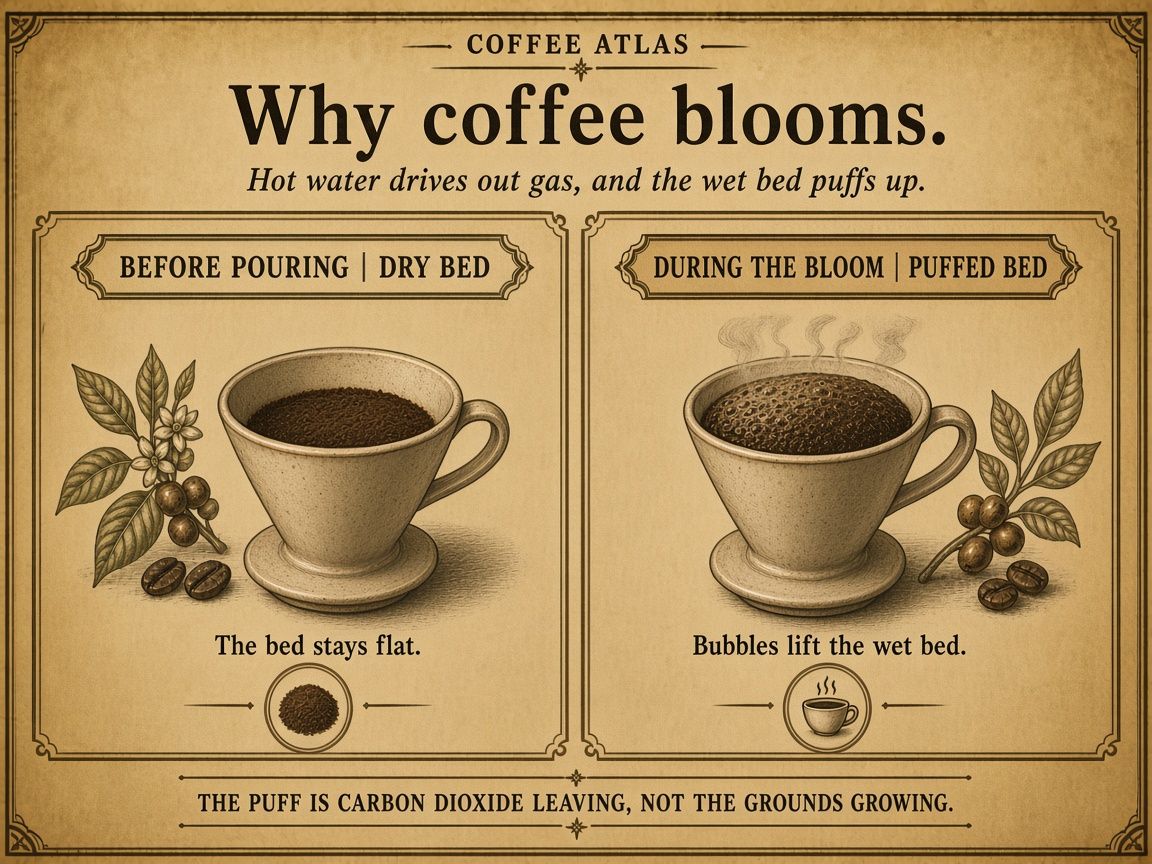
During the bloom, the wet coffee bed puffs up and bubbles because roasting left carbon dioxide in the roasted structure, and hot water drives that gas out. A lively bloom often means more gas is still present. That can be a freshness clue, not a score for how good the coffee tastes.
Updated: Sep 14, 2026Reviewed by: Content and layout review
The puff you see is mostly gas lifting a wet bed
When you first pour onto pour-over grounds, the wet bed often swells and bubbles. That stage is the bloom. The grounds are not swelling on their own. Carbon dioxide left in the roasted structure is driven out by hot water, and the bubbles lift grounds that are already stuck together by water.
Coffee that still holds a lot of gas usually blooms more. Coffee that has already lost most of that gas may barely rise.
The sequence of wetting the bed and then continuing the pour is in how to brew pour-over. This page is about why the bed puffs up, and what that movement can tell you.
After hot water wets the grounds, carbon dioxide in the pores leaves as bubbles and lifts the wet bed. This is a concept diagram, not a lab photo.
Where the gas comes from
Roasting browns coffee, creates aroma, and produces a large amount of carbon dioxide. SCA’s Peter Giuliano describes Maillard browning as creating those aromas along with carbon dioxide. The gas is trapped in the cellular network of the roasted bean and slowly leaks through the cell walls, a process coffee people call degassing.
A 2018 study makes the same split: some carbon dioxide leaves during the roast, and some stays in the pores, then comes out later during storage, grinding, and extraction. Whole beans usually lose that gas over days and weeks. Once the coffee is ground, the same loss happens much faster.
The bubbles in the bloom are gas that was already in the grounds. The pour does not create a new cloud of carbon dioxide from nowhere. Waiting after roasting so some of that gas leaves before you brew is what resting coffee is about.
Why hot water makes the bed rise
When hot water wets the grounds, remaining carbon dioxide comes out more quickly as visible bubbles. As those bubbles travel upward, they lift the wet bed into a dome. Perfect Daily Grind notes that the more gas is escaping, the more visible the bloom usually is. Fresher coffee also often holds more gas.
SCA also ties stronger blooms in filter brewing to carbon dioxide that is still trapped in the porous structure of fresh coffee and released during brewing. Thicker espresso crema often comes from the same gas under pressure; see espresso.
Grinding speeds degassing. If the coffee was ground some time ago, or the whole beans have already lost much of their gas, the first pour may not puff much. Storage conditions are in how to store coffee.
A big bloom is not a better cup
A lively bloom usually means more gas is still there, so the coffee is relatively fresh. SCA says fresh coffee produces stronger blooms during filter brewing. Treat that as a freshness clue, not a tasting score.
Roast level also changes what you see. Light roasts often bloom less dramatically. That difference is not an absolute measure of quality.
A quiet bed is not automatic proof that the coffee has spoiled. It may have rested, been ground earlier, or degassed faster in storage. Flavor still has to be tasted. With less gas in the way, water can sometimes wet the grounds more evenly.
Do not rank two different coffees by how high the dome rises. Time after roast, grind size, pouring, and bed depth also change what you see.
Left, more remaining gas usually means a more visible bloom. Right, once much of the gas has left, the bed may barely rise. Height is a freshness clue, not a score for taste.
Why people still wet the bed first
Gas rushing out can also push water away from the grounds, so contact becomes uneven. Perfect Daily Grind frames the bloom as the moment you want that degassing to happen, instead of letting bubbles interrupt the rest of the extraction. Wet the bed, wait until bubbling eases, and later water can reach more of the coffee.
That is a common brewing reason, not a promise of better flavor. Wet the bed, wait until bubbling eases, then continue pouring. That starting method is in how to brew pour-over. The useful pause can change with the coffee.
Pour-over keeps water moving through the bed, which is why blooming comes up so often. Immersion methods also release carbon dioxide and show bubbles when hot water hits the grounds, even if the bed does not pile into the same dome. A French press is a common immersion example.
Common Misconceptions
Does a big bloom mean the coffee will taste better?
No. A large puff usually means more gas is still present. Light roasts often bloom less dramatically, so roast level already changes what you see. SCA notes that fresh coffee produces stronger blooms in filter brewing. That is a freshness clue, not proof that the cup will taste better.
If the bed barely puffs up, is the coffee spoiled?
Not automatically. Once most of the gas has already left, the bed may barely rise. The coffee may have rested, been ground earlier, or degassed faster in storage. That is not, by itself, a verdict that the beans have gone bad.
Do you have to bloom every brew?
It is not a required ritual for every method. In pour-over, water keeps moving through the bed, so wetting the grounds and letting some gas leave first can help later water contact the coffee more evenly. That is a common brewing reason, not a guarantee of better flavor.
Is blooming the same as resting coffee?
No. Resting is waiting after roasting so some gas leaves before you brew. Blooming is the start of the brew, when hot water drives out gas that is still in the grounds. See resting coffee.
Does the bloom have to last 45 seconds?
No. The starting method is in how to brew pour-over. Fresher coffee often holds more gas, so the useful pause can change with the coffee in the brewer.
Peter Giuliano, Coffee Decoded: What is freshly roasted coffee?, Specialty Coffee Association: Explains that Maillard browning creates aroma along with carbon dioxide, which becomes trapped in the cellular network of roasted coffee and slowly leaks through cell walls as degassing. Using carbon dioxide as a freshness guide, whole beans can reasonably be called fresh for about three weeks; grinding speeds the same loss dramatically. The column also links stronger filter blooms and more espresso crema to carbon dioxide trapped in the porous structure and released during brewing.
Angie Molina, Coffee Degassing; What Does It Mean For Brewers & Roasters?, Perfect Daily Grind, 2019: Explains that gas escaping during brewing forms bubbles, which can keep water from wetting the grounds evenly and affect extraction. Industry comments in the piece also describe darker roasts often degassing faster and lighter roasts often needing a longer rest. The article was sponsored by Behmor; the day counts are common practices, not universal limits.
Perfect Daily Grind, Brew Guide: What Are The 3 Phases of Drip Coffee Brewing?, 2017: Treats the bloom as the first stage of drip brewing because hot water drives out carbon dioxide left from roasting. More escaping gas usually means a more visible bloom. Interviewees also describe that gas pushing water away from the grounds, which is offered as a reason to bloom before the main pour. The article also claims carbon dioxide tastes sour; that claim is not treated as settled consensus.