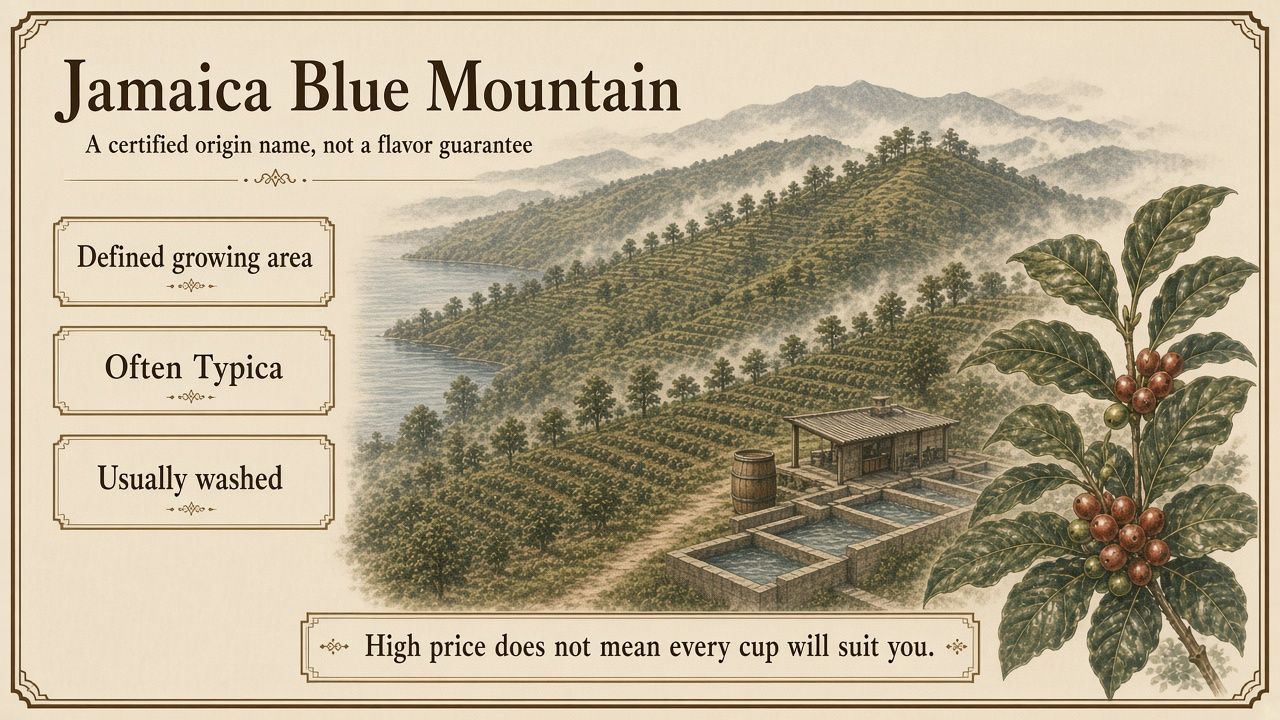
Jamaica Blue Mountain is a licensed origin name, not a separate species. Coffee sold under that name has to be grown in a mapped Blue Mountain area and processed at licensed works. The classic cup is often round, lower in acidity but still lively, with a full, brothy mouthfeel. Blends or “Blue Mountain style” coffees may contain little or none of it.
Updated: Sep 14, 2026Reviewed by: Content and layout review
What Blue Mountain on a bag is telling you
Jamaica Blue Mountain is an origin name, and a regulated one. It is not a separate coffee species.
Jamaica’s 1983 coffee-industry regulations define blue mountain coffee as two conditions at once: the coffee is grown in the Blue Mountain Area listed in the Schedule, and it is processed at licensed coffee works also listed there. That boundary is a mapped zone. It does not turn the whole of Saint Andrew, Saint Thomas, Portland, and Saint Mary into Blue Mountain country. WIPO’s later summary of the same legal framework says only coffee grown between about 3,000 and 5,500 feet (about 910 to 1,675 meters) in those parishes may use the name. Coffee Review writes a similar band up to about 5,600 feet.
The Jamaica Agricultural Commodities Regulatory Authority (JACRA) now licenses the trade. Its subsidiary Coffee Marks Limited owns the Jamaica Blue Mountain® and Jamaican High Mountain Supreme® marks. The Coffee Industry Board (CIB) handled licensing and quality control in earlier decades.
World Coffee Research records that Jamaica still plants Typica widely and calls that planting Jamaica Blue Mountain.
Why the name is famous, and why it costs more
The reputation is old. Coffee Review writes that Blue Mountain has been a celebrated coffee since at least the early nineteenth century, when Jamaica briefly ranked among the world’s largest producers. After World War II, colonial authorities worried that uneven production would ruin the name. The Coffee Industry Board, established in 1950, built a tighter system of regulation.
The high price usually comes from several facts stacked together. The defined growing area is small. Typica yields little and is highly susceptible to diseases such as coffee leaf rust. The name is protected by statute and trademarks. WIPO’s 2010 case study named Japan as the largest importer at the time, and used 2006 retail prices to illustrate the premium.
Coffee Review also records that, even with that fame, some critics said CIB-era Blue Mountain was marketed on the name while the coffee itself was ordinary. In the 1970s and 1980s, some mills shifted to mechanical demucilaging. Volume rose; cup quality often fell. The licensed name tells you where the coffee was grown and processed. It does not tell you that every lot will cup the same way.
How the cup often tastes
A licensed Blue Mountain lot is a fair place to expect a rounder Caribbean profile, not the sharper, more dramatic acidity often associated with Kenya. Coffee Review describes the classic profile as round, low in acidity but still vibrant, full in mouthfeel, with a deep, brothy resonance. Persistent fog slows seed development, so beans can be denser than the modest elevation numbers might suggest elsewhere.
Mill, elevation within the zone, and roast all change the cup. Coffee Review names Mavis Bank as a mill then respected for traditional processing, and notes that some private farms may process their own fruit.
Processing is usually washed. WIPO describes a traditional sequence: ripe cherry is pulped, wet beans move to authorized works within 24 hours, the coffee is sun-dried, then cured in wooden silos or jute sacks for at least eight weeks before hulling, polishing, and hand-sorting. That is an account of the traditional method; Coffee Review also notes that some mills later used mechanical demucilaging. Check the individual lot for the actual process.
If you want sharper black-currant acidity, Kenya is named more often. Classic Blue Mountain leans round, full, and quietly lively rather than piercing. Both can be excellent; they emphasize different parts of the cup.
Blue Mountain, High Mountain, and “style”
Jamaica grows more than Blue Mountain. WIPO records three commercial types from the CIB era: Jamaica Blue Mountain, Jamaica High Mountain Supreme, and Jamaica Prime. JACRA still treats High Mountain Supreme as a separate licensed mark, and describes High Mountain as premium grades grown outside the Blue Mountain area. Coffee Review uses elevation bands instead: about 3,000 to 5,600 feet for Blue Mountain, 1,500 to 3,000 feet for High Mountain, and below that for Supreme or Low Mountain. The trademark names and those elevation labels are close, but they are not a single matching list. High Mountain is not a cheaper grade of Blue Mountain, and it cannot automatically use that name.
Three Jamaican names as a sketch, not a surveyed elevation map or a photograph of any farm. High Mountain Supreme is the licensed wording in current trademark use.
Labels get blurrier once blends enter the shelf. Coffee Review describes Blue Mountain blends that contain very little of the coffee, and Blue Mountain “style” blends that contain none. Those coffees can still taste good. They are not the licensed origin. Read the origin claim first, then decide whether the name is what you are paying for.
A licensed origin name is not the same as a flavor nickname. This is a concept sketch, not a certificate or a shop photograph.
Common Misconceptions
Is Jamaica Blue Mountain always better?
No. Blue Mountain is a licensed origin name. Classic descriptions emphasize roundness and acidity that is lower but still lively. If you prefer Kenya’s sharper acidity or a more floral Ethiopian cup, you may not like it better. Lots under the same name still vary by mill and roast.
If the bag says Typica, is it Blue Mountain?
Not by itself. Typica is a variety; Blue Mountain is an origin name. World Coffee Research notes that Jamaica still plants Typica under the Jamaica Blue Mountain name, but Typica also grows in Peru, the Dominican Republic, and elsewhere.
Does “Blue Mountain style” or a Blue Mountain blend count?
Usually not as the origin. Coffee Review describes blends that contain very little Blue Mountain, and “style” coffees that contain none. Look for the licensed Jamaican origin claim, not a flavor nickname.
Is High Mountain a cheaper grade of Blue Mountain?
No. High Mountain Supreme is a separate licensed name for Jamaican coffee grown outside the defined Blue Mountain area. It is not a discount tier of Blue Mountain, and it cannot automatically use that name.
Why is it so expensive?
The mapped growing area is small, Typica yields are low, and the name is protected by regulation and trademarks. Limited supply plus brand premium keep prices high. The price explains the name, not whether the cup will suit you.
WIPO, In Search of a Perfect Cup, last updated 2010: Summarizes regulations under the Coffee Industry Regulation Act: only coffee grown between about 3,000 and 5,500 feet in the parishes of Saint Andrew, Saint Thomas, Portland, and Saint Mary may be called Jamaica Blue Mountain. Dates coffee's introduction to the island to 1728. Describes a traditional sequence of pulping, moving wet beans to authorized works within 24 hours, sun-drying, and curing in wooden silos or jute sacks for at least eight weeks. At the time, the Coffee Industry Board held the marks through Coffee Marks Limited and distinguished Jamaica Blue Mountain, Jamaica High Mountain Supreme, and Jamaica Prime. Japan is named as the largest importer in that case study. The 2006 retail-price comparison is historical, not a current price.
The Coffee Industry (Amendment) Regulations, 1983, Jamaica Gazette Supplement, 16 November 1983: Defines blue mountain coffee as coffee grown in the Blue Mountain Area described in the Schedule and processed at licensed coffee works listed in the Schedule. The boundary is a mapped area, not the whole of four parishes. Use of the Blue Mountain name required written authorization from the Coffee Industry Board.
Jamaica Agricultural Commodities Regulatory Authority, Coffee introduction: JACRA now licenses and monitors coffee dealers, manufacturers, processors, works, and nurseries, and oversees trademark licensing. Coffee Marks Limited, a wholly owned JACRA subsidiary, owns the Jamaica Blue Mountain® and Jamaican High Mountain Supreme® marks.
Jamaica Agricultural Commodities Regulatory Authority, About coffee: Names Arabica Typica as the dominant variety being propagated, and notes that Typica is not a heavy producer. Places cultivation in the Blue Mountain Area (Saint Thomas, Saint Andrew, and Portland) and in the High Mountain region outside that area. Promotional ranking and 'best coffee' language on the same page are not used as facts here.
World Coffee Research, Typica: Records that the English introduced Typica from Martinique to Jamaica in 1730. Aliases include Blue Mountain. Typica remains widely planted in Jamaica, where it is called Jamaica Blue Mountain. Low yield and high susceptibility to major diseases, including coffee leaf rust. The 1730 date does not match WIPO's 1728 introduction year.
Kenneth Davids, Jamaica, Coffee Review, excerpted from 21st Century Coffee: A Guide: Describes classic Blue Mountain as a Caribbean cup: round, low in acidity but vibrant, full in mouthfeel, with a deep, brothy resonance. Fog slows seed development. After World War II the Coffee Industry Board tightened regulation. In the 1970s and 1980s some mills shifted to mechanical demucilaging; volume rose and quality often fell. Names Mavis Bank as a mill then respected for traditional processing. Warns that Blue Mountain blends may contain very little of the coffee, and that 'style' blends may contain none. Places the licensed Blue Mountain band at 3,000 to 5,600 feet, close to but not identical with WIPO's 5,500-foot ceiling, and uses High Mountain / Supreme or Low Mountain names that do not line up one-for-one with High Mountain Supreme and Prime.