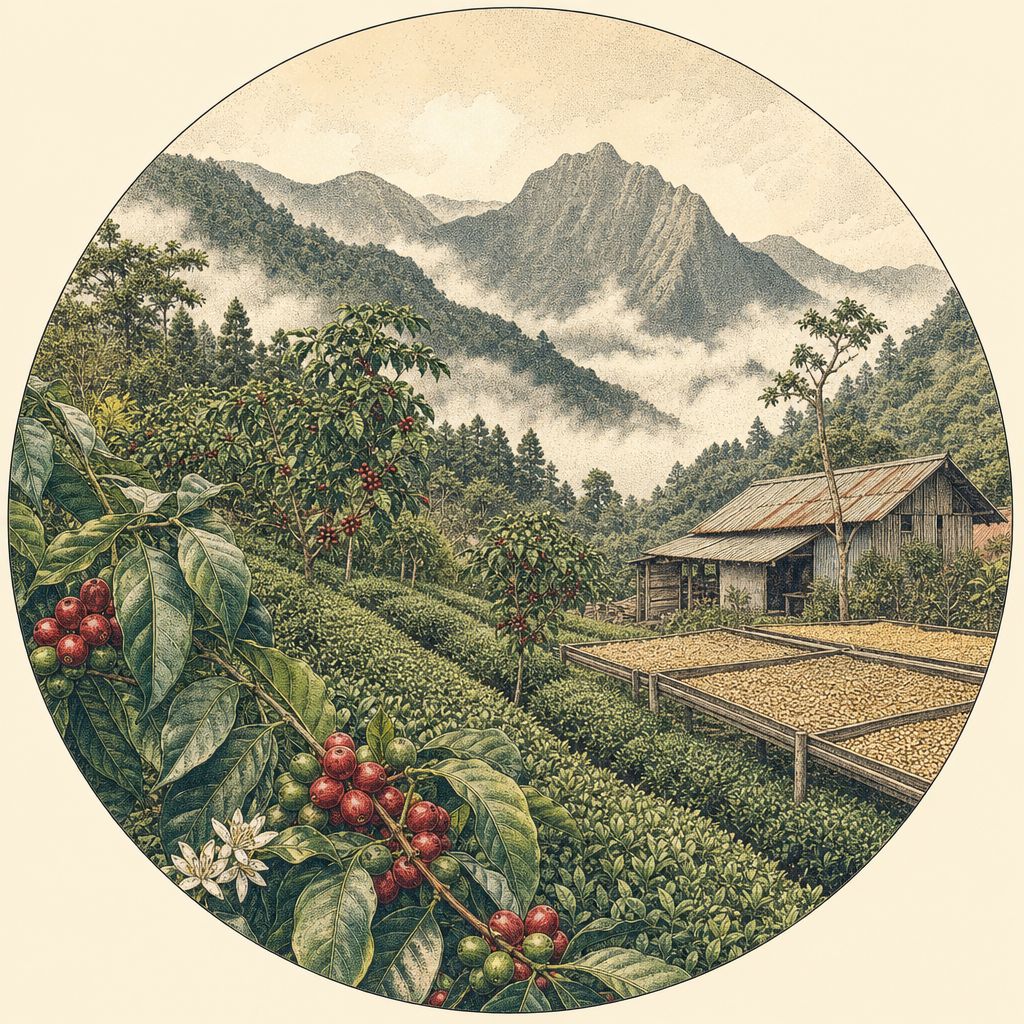
Taiwan produces specialty coffee, but domestic volume is small beside imports. About 905 metric tons were harvested in 2024, while imports reached 52,587 metric tons. Region, farm, process, traceability, and evaluated lot matter more than a single “Taiwan flavor.”
Updated: Aug 26, 2026Reviewed by: Ah-Zhu (English-site batch review)
Local specialty coffee in a major importing market
Taiwan grows and evaluates specialty coffee. The Agriculture and Food Agency has positioned domestic production around distinctive origin, quality, safety, and specialty value, and a national green-coffee evaluation began in 2012. Estate lots, award lots, organic coffee, and traceable domestic coffee all reach consumers. The Tropic of Cancer crosses the island, so Taiwan often sits near the northern edge of the typical coffee belt.
The scale is small. Taiwan’s official 2024 report listed 1,216.20 hectares and a harvest of 904,960 kilograms—about 905 metric tons. Ministry of Finance statistics placed 2024 coffee imports at 52,587 metric tons, a record. These figures are not directly identical product categories at every stage, but the scale difference is unmistakable: most coffee served in Taiwan is imported.
The illustration shows the difference in scale and is not an exact proportional chart.
High land and labor costs make it difficult for local farms to compete with imported commodity coffee. Traceability, farm identity, evaluation, tourism, organic certification, and careful postharvest work provide a more realistic market position. Specialty orientation is a strategy—not proof that every locally grown lot meets specialty standards.
A coffee history with several restarts
Official historical sources give 1881 and 1884 as two early introduction dates. Coordinated development expanded under Japanese rule. Trials in Chiayi identified arabica as the more suitable species in 1917, and planted area approached 1,000 hectares by 1942 before war and abandonment reduced production.
Postwar projects revived coffee for a time around Douliu. Another modern revival followed the 1999 Jiji earthquake as rural areas combined local identity, agriculture, and tourism. Acreage again exceeded 1,000 hectares by 2016, and green-coffee harvest passed 1,000 metric tons in 2018.
Taiwanese coffee does not grow only at mountain elevations. An official agricultural research release divided recent acreage at roughly 30% high elevation and 35% each at middle and lower elevations. That range makes one national flavor claim especially unreliable.
Where coffee grows in Taiwan
Pingtung led 2024 harvest volume, followed by Nantou, Chiayi, and Taitung. Frequently marketed names include Alishan and Meishan in Chiayi; Guoxing, Ren’ai, and Shuili in Nantou; Wutai, Sandimen, Taiwu, and Chunri in Pingtung; Dongshan in Tainan; Gukeng in Yunlin; and growing areas in Miaoli, Kaohsiung, Hualien, and Taitung.
Bag labels may use a county, township, mountain area, estate, or local brand rather than one standardized region system.
Gukeng is historically important because of Japanese-era and postwar production in Yunlin, but it is not the largest current source by harvest volume. Alishan is prominent in national evaluations. Eastern production in Hualien and Taitung occupies a different landscape of mountains, valleys, and Pacific influence.
How to evaluate Taiwanese coffee
Read it as you would any single-origin coffee: producer, precise place, elevation, variety, harvest, process, drying, evaluation record, and roast date. Washed and natural processing are both common, and farms also experiment with controlled fermentation.
Taiwan’s Agricultural Research Institute released Tainung No. 1 as the first locally bred coffee variety, suited to middle and lower elevations. The institute reported nutty aroma, mild fruit acidity, fuller body, yield above the domestic cultivated-variety average, and samples above 82 SCA points at low elevation. Those are agency results for that material, not a promise for all Taiwanese coffee.
When choosing Taiwanese coffee, consider its traceability, the local farms behind it, and the qualities of the individual lot.
Common Misconceptions
Does Taiwan produce specialty coffee?
Yes. National and local green-coffee evaluations, traceable estate lots, and specialty-focused producers are well established. The total crop remains small.
Is most coffee consumed in Taiwan grown locally?
No. Taiwan harvested about 905 metric tons in 2024 and imported 52,587 metric tons that year, so most everyday coffee uses imported beans.
Is Gukeng Taiwan's largest current coffee region?
No. Gukeng is historically important, but 2024 harvest volume was led by Pingtung, followed by Nantou, Chiayi, and Taitung.
Does Taiwanese coffee have one typical flavor?
No. Elevation, microclimate, variety, processing, farm skill, and roast differ widely. Use Taiwan as the country of origin, not a fixed tasting note.
翁世豪、劉千如,臺灣咖啡簡史,農業部茶及飲料作物改良場: Official history covering early introductions, Japanese-era trials and acreage, postwar revival, and the national specialty green-coffee evaluation begun in 2012.
台灣咖啡沿革,農業知識入口網: Official historical context for experimental cultivation, wartime decline, post-1999 revival, and recent acreage and harvest milestones.
113年度年報(咖啡),農業知識入口網: Reports cultivated area, harvest volume, and production rankings by county for 2024.
農業部農業試驗所,首個本土育成咖啡品種「台農1號」: Reports the distribution of coffee cultivation by elevation and compares domestic production with imports. It also introduces the locally bred Tainung No. 1 variety and the agency’s assessment of its cup quality.
財政部統計通報,我國咖啡市場概況,2025年2月: Reports coffee import volume for 2024 alongside recent domestic production figures.
農糧署南區分署,國產咖啡朝精品發展: Discusses Taiwan’s focus on specialty coffee, traceability and certification, and commonly highlighted producing areas.
咖啡產地,農業知識入口網農漁生產地圖: Official list of common coffee-producing townships across Taiwan.
農糧署,2026年臺灣咖啡新產季登場: Describes major production areas in western and eastern Taiwan for the 2026 season, where natural and washed processing are common.
農糧署東區分署,東部優質咖啡 山與海的醇厚原味: Geographic context for Hualien and Taitung production influenced by Taiwan's eastern landscape.
花蓮縣政府,113年花蓮縣第8屆精品咖啡評鑑成果揭曉: Documents Hualien's long-running local specialty evaluation and organic-farm context.