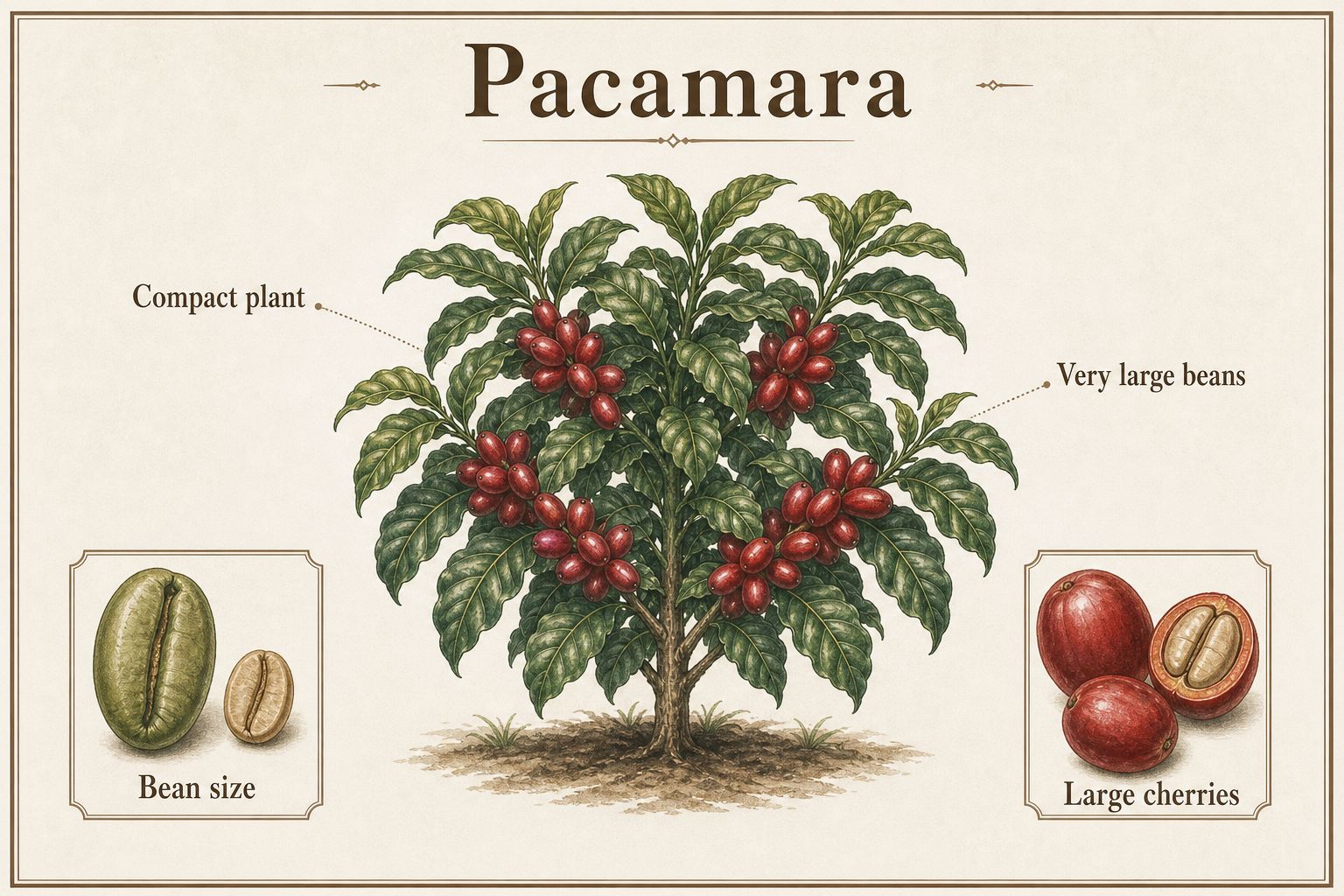
Pacamara is an arabica variety bred in El Salvador by crossing compact Pacas with giant-beaned Maragogipe. It combines a compact plant with very large beans and exceptional high-elevation quality potential, but is highly susceptible to coffee leaf rust and varies from one generation to the next.
Updated: Aug 31, 2026Reviewed by: Content and layout review
A Salvadoran cross built for large beans on a compact tree
Pacamara is an arabica variety created in El Salvador. The Salvadoran Institute of Coffee Research (Instituto Salvadoreño de Investigaciones del Café, ISIC) crossed Pacas with Maragogipe, then carried out an incomplete pedigree selection. The name combines the first four letters of each parent variety’s name.
World Coffee Research places Pacamara in the Bourbon-Typica group and describes a compact plant with very large beans. Yield potential is low, with meaningful harvest commonly beginning in the third year. Although WCR rates its high-elevation quality potential as exceptional, it is highly susceptible to coffee leaf rust, nematodes, coffee berry disease, and Ojo de Gallo (American leaf spot).
The catalog also notes that Pacamara’s traits vary from one generation to the next. For buyers, the name identifies the variety, but does not guarantee a particular flavor; check the rest of the bag for origin and processing information.
Pacas for stature, Maragogipe for seed size
Pacas contributes a compact growth habit that allows closer planting, while Maragogipe contributes very large beans.
Pacas is a natural dwarf mutation of Bourbon, comparable to Caturra in Brazil and Villa Sarchi in Costa Rica. World Coffee Research traces it to a 1949 discovery on a Pacas-family farm in Santa Ana, El Salvador. ISIC began pedigree selection in 1960, and Pacas still accounts for about a quarter of El Salvador’s production. Its beans are average in size.
Maragogipe is a natural mutation of Typica, found near the Brazilian city of Maragogipe in 1870. A single dominant gene gives it unusually large beans, internodes, and leaves. Its tall trees produce low yields, which is why WCR considers Pacamara a better planting option.
Coffee Review dates the ISIC experiments to 1958, while the Perfect Daily Grind interview says the selected material reached producers in the late 1980s, after about thirty years of work. These dates refer to the start of breeding and the later release to growers, respectively.
Pacamara combines Pacas stature with Maragogipe seed size. This is a lineage sketch, not a field identification plate.
Large beans, different plant
Pacamara and Maragogipe, often called elephant bean, are distinct varieties despite their similarly large beans.
World Coffee Research lists both varieties as very large-beaned, although Coffee Review notes that Pacamara beans are generally smaller than Maragogipe. Their growth habit provides a clearer distinction: Pacamara is compact, while Maragogipe is tall.
Maracaturra is a different variety that likely arose from a natural Caturra × Maragogipe cross in Nicaragua. World Coffee Research notes that its traits were never stabilized.
Pacamara has a compact plant and large beans; Maragogipe grows taller and has even larger beans. This illustration shows typical traits and cannot be used to identify a plant.
Why the cup is not always the same
World Coffee Research describes Pacamara’s pedigree selection as incomplete and reports that its traits vary from one generation to the next. Coffee Review estimates that about 10% to 40% of seedlings more closely resemble one parent, requiring growers to select seedlings before planting them in the field.
That variation also affects flavor. A lot labeled Pacamara may have the lighter, woodier character associated with Maragogipe, so an unexpected flavor does not necessarily mean the variety was mislabeled.
World Coffee Research evaluated yield and rust response at 23 sites in 15 countries, with local results depending on which rust races are present. Although the compact plants allow closer spacing, growers still need to manage the risk of leaf rust.
How Pacamara often tastes
WCR rates Pacamara’s high-elevation quality potential as exceptional and notes that it frequently appears among high-placing El Salvador Cup of Excellence lots. The rating describes quality potential rather than specific flavors.
Coffee Review describes all-Pacamara lots as typically deep, savory-sweet, and resonant, sometimes with floral top notes. Washed processing remains traditional for specialty export lots; natural-processed Pacamaras can emphasize that savory-floral depth. Those are sample observations, not a promise that every bag will taste the same.
If a bag says Pacamara, expect a Salvadoran-bred variety with large beans, high quality potential, and variable traits among its offspring. Bean size alone does not mean the coffee will be heavier, fruitier, or easier to recognize than Bourbon or Caturra.
Common Misconceptions
Is Pacamara the same as elephant bean?
No. Elephant bean usually means Maragogipe. Pacamara is a Pacas × Maragogipe cross. The plant is compact, and the beans are very large, though typically a bit smaller than Maragogipe.
Is Pacamara related to Bourbon and Typica?
Yes. Pacas is a Bourbon mutation, and Maragogipe is a Typica mutation. Pacamara carries ancestry from both groups without being either parent.
Do larger beans guarantee a better cup?
No. World Coffee Research rates Pacamara's high-elevation quality potential as exceptional and Maragogipe's as very good, but those ratings are not determined by bean size.
Why can two Pacamara lots taste so different?
Pacamara's traits vary from one generation to the next, as World Coffee Research notes. Coffee Review estimates that about 10% to 40% of seedlings more closely resemble one of the parents.
Is Pacas the same as Pacamara?
No. Pacas is one parent and has average-size beans. The two names are not interchangeable on a bag.
World Coffee Research, Pacamara: Describes Pacamara as a Pacas × Maragogipe cross developed through incomplete pedigree selection by ISIC and classified in the Bourbon-Typica group. The compact plants have very large beans, low yields, and first production in the third year. The catalog records susceptibility to several diseases, including Ojo de Gallo, and rates high-altitude quality potential as exceptional. It also notes variation among offspring, primary cultivation in El Salvador, and prominence in Cup of Excellence competitions.
World Coffee Research, Pacas: Establishes Pacas as a single-gene dwarf mutation of Bourbon, similar to Caturra and Villa Sarchi, discovered in 1949 on a Pacas-family farm in Santa Ana, El Salvador. ISIC began pedigree selection in 1960. Pacas still accounts for about 25% of national production and reached Honduras via IHCAFE in 1974.
World Coffee Research, Maragogipe: Establishes Maragogipe as a natural Typica mutation discovered near Maragogipe, Brazil, in 1870. A single dominant gene enlarges beans, internodes, and leaves. The plant is tall, low-yielding, and rust-susceptible. WCR considers Pacamara a better planting option because of Maragogipe's low productivity.
Kenneth Davids, El Salvador, Coffee Review (from 21st Century Coffee: A Guide): Dates the start of ISIC experiments to 1958 and describes Pacamara beans as large but generally smaller than Maragogipe. The article describes rich, savory-sweet flavors in all-Pacamara lots from El Salvador; these observations do not predict every lot. It also reports that roughly 10% to 40% of seedlings more closely resemble one parent and that the variety remains susceptible to leaf rust.
Interview: What’s So Special About Pacamara?, Perfect Daily Grind, 2015: Explains the name and reports that the 1958 cross reached producers in the late 1980s after about thirty years of work. The interview's flavor descriptions are personal observations rather than characteristics of every lot. Its claim about Pacas disease resistance conflicts with WCR, which this article follows for disease information.