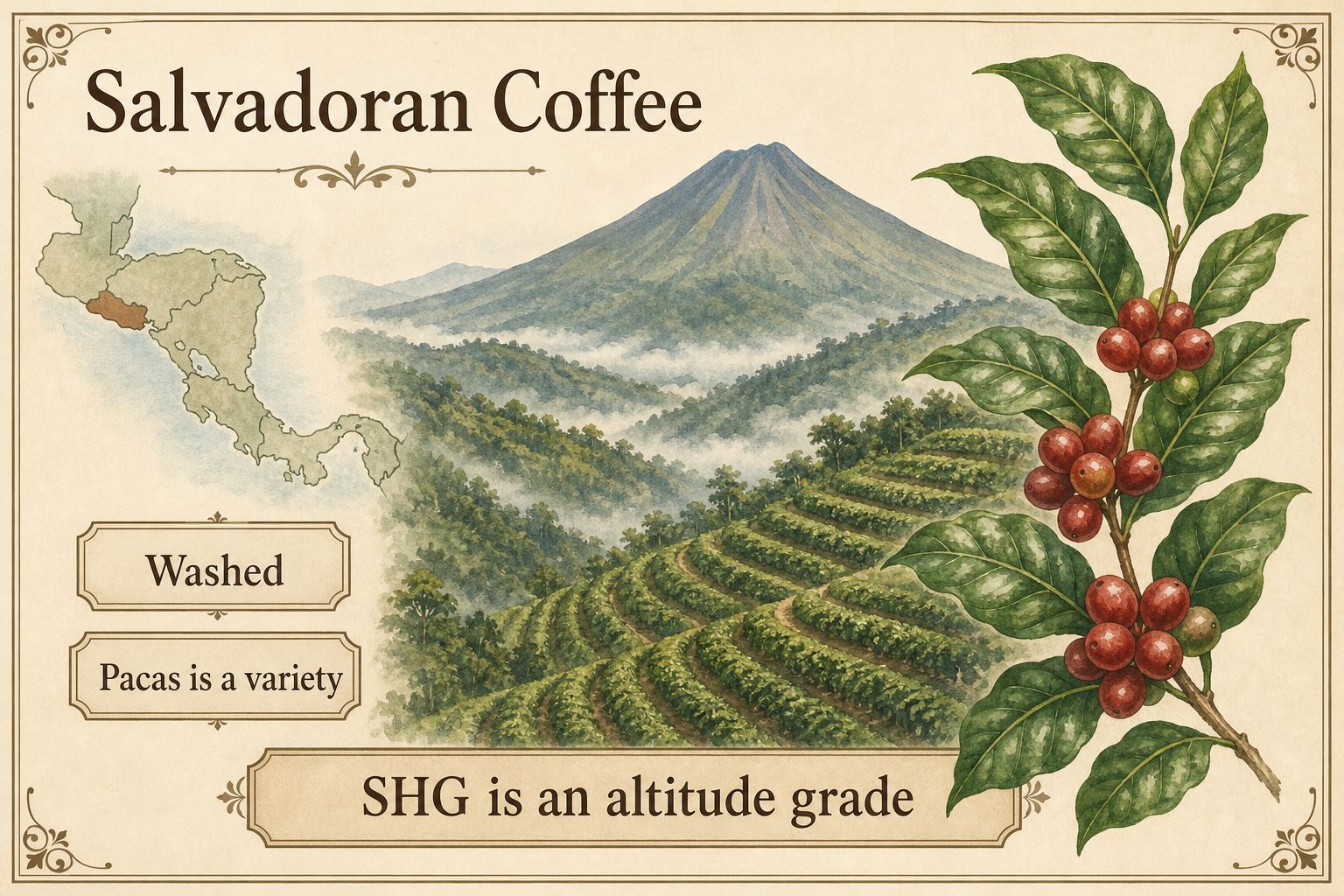
What Does Salvadoran Coffee Taste Like—and How Does It Relate to Pacas?
Salvadoran specialty lots are usually high-grown washed arabica. Coffee Review describes the traditional cup as quite sweet, smooth, and usually clean. Farms long favored Bourbon, plus Pacas, a local dwarf mutation, and Pacamara, a later cross. SHG is an altitude grade, not cup quality.
Updated: Aug 30, 2026Reviewed by: Content and layout review
What the bag is naming
El Salvador on a bag is usually high-grown washedarabica. Coffee Review describes the traditional cup as quite sweet, smooth, and usually clean.
USDA puts the 2025/26 crop near 586,000 sixty-kilogram bags, almost all arabica, on about 118,000 harvested hectares. That is far smaller than the early 1970s, when Coffee Review notes the country ranked fourth or fifth in the world by volume. Leaf rust later cut the crop again.
If the bag is labeled SHG, that is Strictly High Grown. Coffee Review writes that SHG lots may be brighter and fuller-bodied than High Grown. It is an altitude grade, not cup quality.
Country on the left, variety in the center, altitude grade on the right. All three can appear on one bag. The meter marks are schematic, not an SHG cutoff.
For a shopper, the next question is often whether the lot is Bourbon, Pacas, or Pacamara. The country name does not tell you which plant is in the bag.
How Pacas, Bourbon, and Pacamara fit
Pacas is a variety found in El Salvador. World Coffee Research traces it to a 1949 discovery on a Pacas-family farm in Santa Ana: a dwarf mutation of Bourbon. The catalog still puts it at about a quarter of national production.
Coffee Review notes that before the rust epidemic, Bourbon made up about 70% of the crop, including the Tekisic selection. All-Bourbon lots tend to be juicier and more pungently fruit-toned. Pacas stays compact and is often sold mixed with Bourbon, usually with less distinctive cup character. Shared aromas for Bourbon and Pacas include quiet flowers, stone fruit and berry, gently pungent citrus, and sometimes chocolate.
Pacamara is a later cross of Pacas and Maragogipe, selected in the country. Coffee Review describes all-Pacamara lots as deep, savory-sweet, and resonant, often with floral top notes. USDA notes that Gesha and Pacamara still led high scores at the 2025 Cup of Excellence. For the history of the cross and the variation among its offspring, see the Pacamara page.
A bag that says El Salvador names an origin. A bag that says Pacas names a plant.
Bourbon on the left, Pacas in the center, Pacamara on the right. The figure marks names, not a diagnostic photo.
Process, regions, and rust
Traditional export lots are wet-processed, usually by ferment-and-wash. Coffee Review also writes that specialty mills run natural and honey lots too; natural Pacamaras can be especially distinctive. Those experiments picked up after rust and falling green prices, as farms tried to differentiate lots.
Most production is concentrated in the center-west, including Apaneca and Santa Ana, as Coffee Review notes. The far northwest, in the mountains near Honduras, grows less coffee but can still produce excellent lots. USDA reports that the Salvadoran Coffee Institute works with six regions on geographical indications. Regional names provide useful context, although variety and processing often create larger flavor differences.
Leaf rust hit Central America in 2012–13. Coffee Review reports an extraordinary 60% drop in Salvadoran production from 2012/13 to 2013/14. Bourbon and Pacamara have little rust resistance. Specialty farms still keep both varieties; commodity lots are the ones more likely to switch to rust-resistant hybrids. USDA lists Pacas, Pacamara, Sarchimor, and Marsellesa among seedlings distributed to smallholders.
High-grown washed arabica with a sweet, smooth cup is a common Salvadoran profile. Pacas identifies a variety, while SHG indicates an altitude grade. These labels do not guarantee Bourbon or a more distinctive flavor than coffee from a neighboring origin.
Common Misconceptions
Is Pacas just another name for El Salvador?
No. Pacas is a variety discovered in El Salvador. A bag labeled only El Salvador does not establish that the coffee is Pacas.
Is Salvadoran coffee always sweet and clean?
Traditional washed lots are often described that way, but variety, processing, and roasting can produce different flavors.
Does SHG guarantee better coffee?
No. SHG is an altitude grade. Coffee Review says it may be brighter and fuller-bodied than HG. That is not a cupping score.
Is Salvadoran coffee always washed?
Traditional exports are usually washed, while specialty mills also produce natural and honey-processed lots, especially Pacamara. Check the processing information on the bag.
Do farms still grow Bourbon after rust?
Specialty farms still keep Bourbon and Pacamara. Commodity lots are the ones more likely to switch to rust-resistant hybrids. Government seedling lists include Pacas, Pacamara, and Sarchimor.
USDA Foreign Agricultural Service, Coffee Annual, El Salvador, ES2026-0004, 2026: Reports production of about 586,000 60-kg bags in marketing year 2025/26 and a forecast of 542,000 bags for 2026/27, with about 118,000 hectares harvested. The production, supply, and distribution table lists only arabica. SCI works with six regions on geographical indications, while seedlings distributed to smallholders include Cuscatleco, Marsellesa, Pacas, Pacamara, Sarchimor, and Anacafe 14. High-scoring Geisha and Pacamara lots led the 2025 Cup of Excellence results. Production figures do not indicate the flavor of an individual lot.
Kenneth Davids, El Salvador Coffee, Coffee Review, excerpted from 21st Century Coffee: A Guide: Traditional cup quite sweet, smooth, usually clean. All-Bourbon lots more robustly juicy and pungently fruit-toned; all-Pacamara lots deep, savory-sweet, resonant, often with floral top notes. Bourbon and Pacas aromas: quiet flowers, stone fruit and berry, gently pungent citrus, sometimes chocolate. Traditional export wet-processed; specialty experiments with natural and honey. Volume centered west-central, including Apaneca and Santa Ana; modest excellent lots in the far northwest near Honduras. About a 60% production drop from 2012/13 to 2013/14 after rust. Before the epidemic, about 70% Bourbon including Tekisic. Pacas often blended with Bourbon. SHG may be brighter and fuller-bodied than HG.
World Coffee Research, Pacas: Natural Bourbon mutation found in Santa Ana in 1949. WCR still puts it at about a quarter of national production. Full story on the Pacas page.