What Is Maragogipe—and How Is It Different From Pacamara?
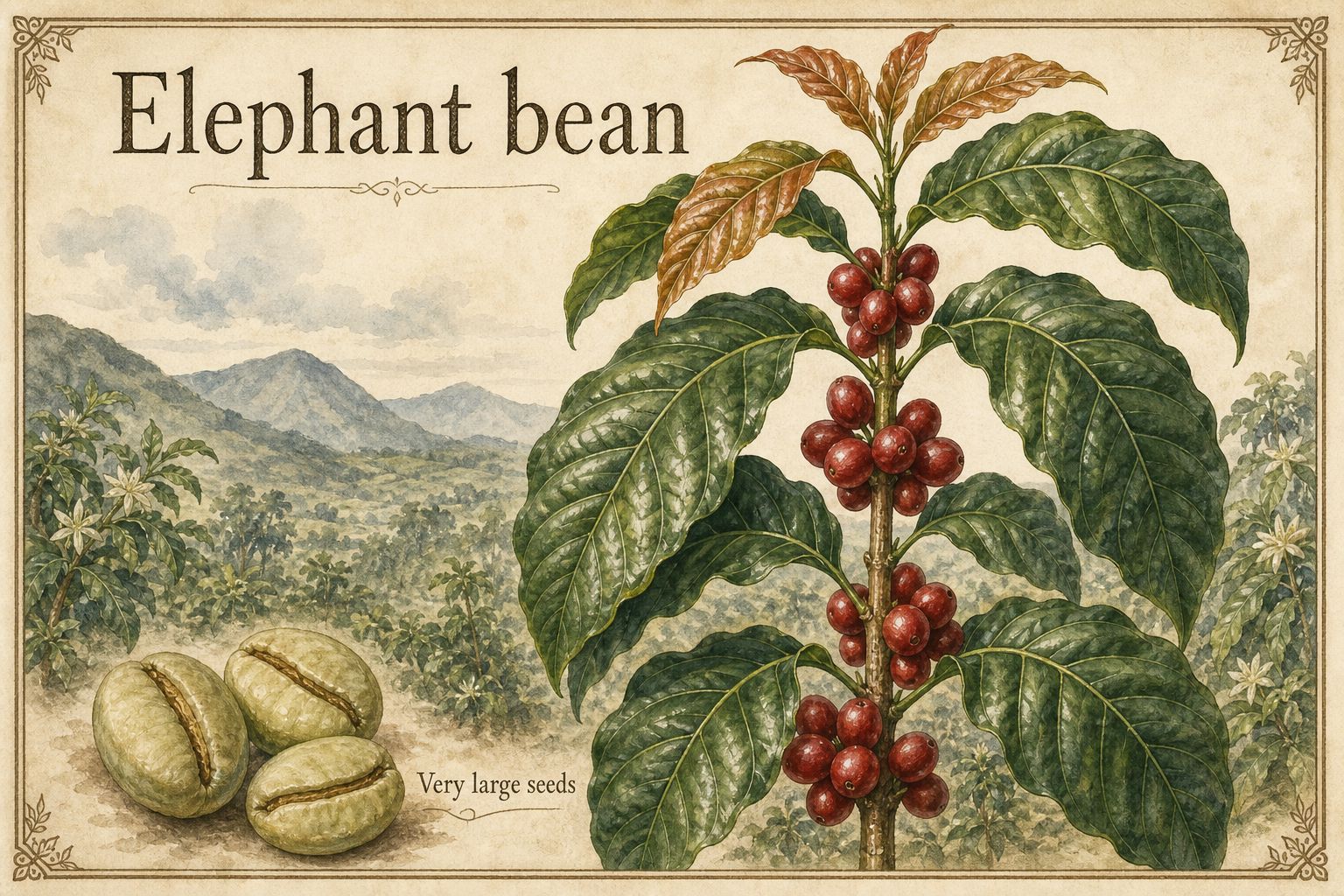
Maragogipe, often sold as elephant bean, is a natural Typica mutation found near Maragogipe, Brazil, in 1870. A single dominant gene gives it unusually large beans, internodes, and leaves, while the tall trees produce low yields and are susceptible to leaf rust. World Coffee Research rates its high-elevation cup quality potential as very good.
Updated: Aug 31, 2026Reviewed by: Content and layout review
What Maragogipe means on a coffee bag
Maragogipe, often sold as elephant bean, identifies the coffee variety. Check the other details on the bag for its origin and processing method.
World Coffee Research describes Maragogipe as a natural Typica mutation found near Maragogipe, Brazil, in 1870. A single dominant gene enlarges the beans, internodes, and leaves, producing tall plants with bronze-colored new leaf tips and very large beans. Yield is low, with first production commonly in year four, and the variety is susceptible to leaf rust, nematodes, and coffee berry disease. WCR rates its high-elevation quality potential as very good.
Maragogipe is now uncommon, and World Coffee Research considers Pacamara a better planting option because of Maragogipe’s low productivity.
How Typica became a giant
Maragogipe is closely related to Typica, with a mutation that enlarges several plant structures.
Krug and Carvalho, writing in Bragantia in 1942, call it a gigas form of Typica: larger leaves, flowers, and fruit, taller plants, and low productivity. They describe an 1870 find by Crisógono José Fernandes in the municipality of Maragogipe, Bahia, and genetic work at Campinas from 1933. They concluded that one pair of almost completely dominant genes controls these traits.
World Coffee Research also records single-stem planting density around 3,000 to 4,000 plants per hectare, in line with other tall Typica-related trees. The catalog also rates the cherry-to-green-bean ratio as very high, meaning a high share of the fruit remains as green coffee.
The diagram compares Typica (left) with Maragogipe's larger leaves and cherries (right); it cannot identify an individual plant.
How it differs from Pacamara
Both varieties have very large beans, but their origins and growth habits differ.
Pacamara is a Pacas × Maragogipe cross from El Salvador. World Coffee Research lists both as very large-beaned, although Coffee Review notes that Pacamara beans are generally smaller than Maragogipe. Plant stature provides a clearer distinction: Maragogipe is tall, while Pacamara is compact.
Maracaturra is another related name, described by World Coffee Research as a likely natural Caturra × Maragogipe cross from Nicaragua whose traits were never stabilized. The Pacamara article provides further context.
Maragogipe is tall (left), while Pacamara is compact (right), and both have very large beans. The diagram cannot be used for variety identification.
How it often tastes
WCR rates Maragogipe’s high-elevation quality potential as very good, with its catalog summary describing Central American quality as good to very good. Actual sensory quality still depends on environment, processing, and roasting.
Coffee Review describes very large, porous beans whose flavor is influenced by soil and origin. Kenneth Davids’ view in the article is that, under the same growing conditions, Maragogipe often has lighter flavor and lower acidity than other traditional arabicas. This is an observed tendency rather than a rule for every lot.
According to Coffee Review, most Maragogipe sold in North America comes from Mexico, Nicaragua, or Guatemala, with lots from Chiapas and Cobán holding the strongest reputation.
Maragogipe or elephant bean identifies a tall Typica mutation with very large seeds. Bean size alone cannot predict body, brightness, or bitterness.
Common Misconceptions
Is Maragogipe the same as Pacamara?
No. Elephant bean usually means Maragogipe. Pacamara is a Pacas × Maragogipe cross. The plant is compact, and the beans are very large, though typically a bit smaller than Maragogipe.
Is Maragogipe the same variety as Typica?
No. It is a natural mutation of Typica, with a taller plant and larger beans. They are genetically related but remain distinct varieties.
Do larger beans guarantee a better cup?
No. World Coffee Research rates Maragogipe's high-elevation quality potential as very good and Pacamara's as exceptional. Bean size alone does not determine cup quality, and these ratings do not guarantee the quality of an individual lot.
Why is Maragogipe hard to find?
Its very low yield makes it a less common planting choice.
Does elephant bean always come from Brazil?
The mutation was found in Brazil. Coffee Review says most Maragogipe bought in North America comes from Mexico, Nicaragua, or Guatemala.
World Coffee Research, Maragogipe: Records a natural Typica mutation discovered near Maragogipe, Brazil, in 1870, with a single dominant gene enlarging beans, internodes, and leaves. Plants are tall with bronze-colored leaf tips, very large beans, low yield, and first production in year four; they are susceptible to leaf rust, nematodes, and coffee berry disease. High-altitude quality potential is rated very good, while the catalog summary describes Central American quality as good to very good. Listed single-stem density is about 3,000 to 4,000 plants per hectare, with low nutrition requirements and a very high cherry-to-green-bean ratio. Because of Maragogipe's low productivity, WCR considers Pacamara a better planting option, which has Maragogipe as a parent, and also mentions the related Maracaturra.
Krug, C. A. and Carvalho, A., Genética de coffea VII, Bragantia, 1942: Records the 1870 discovery by Crisógono José Fernandes in Maragogipe, Bahia, describing a giant form of Typica with larger leaves, flowers, and fruit, taller plants, and low productivity. Genetic analysis at Campinas began in 1933 and attributed these traits to one pair of almost completely dominant genes.
World Coffee Research, Pacamara: Describes Pacamara as a compact Pacas × Maragogipe cross with very large beans and exceptional high-altitude quality potential. The Pacamara article also discusses the related Maracaturra variety.
Kenneth Davids, Maragogipe (Elephant Beans), Coffee Review: Describes very large, porous beans whose flavor is influenced by soil and origin. Davids' view in the article is that Maragogipe often has lighter flavor and lower acidity than other traditional arabicas grown under the same conditions. Most North American offerings come from Mexico, Nicaragua, or Guatemala, with Chiapas and Cobán holding the strongest reputation.