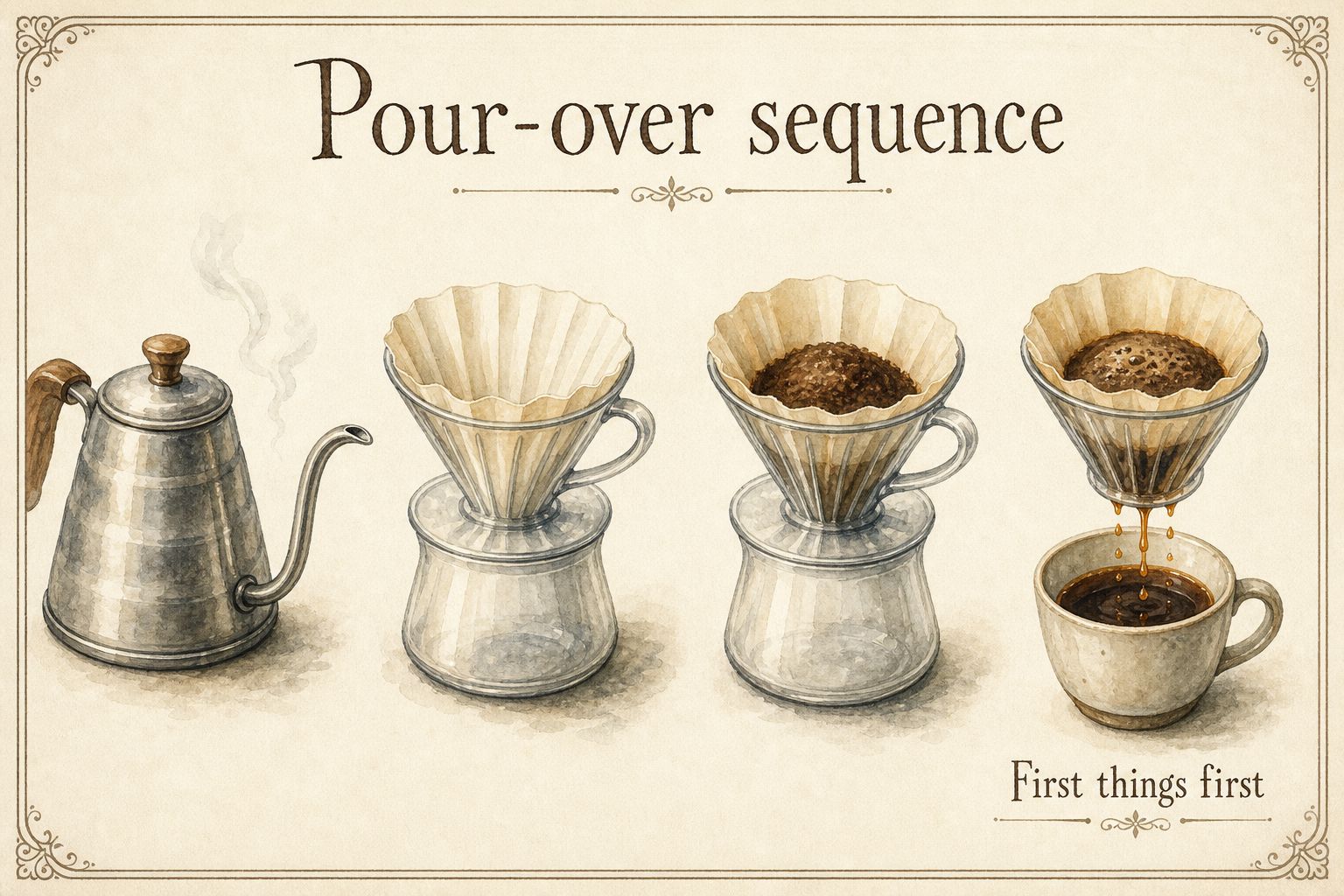
A basic pour-over involves preparation, blooming, and pouring. Heat the water, grind the coffee, and rinse the paper filter before discarding the rinse water. Add the grounds and wet them to release some gas, then continue pouring as gravity draws the coffee through the filter. Brew ratio, grind size, and water temperature affect the final flavor.
Updated: Sep 14, 2026Reviewed by: Content and layout review
From preparation to the finished brew
Pour-over uses water poured by hand through ground coffee and a paper filter. At home, start by understanding the basic sequence: prepare the equipment and grounds, add water for the bloom, then complete the pour and let the coffee drain.
Cone and flat-bottom drippers follow the same broad sequence. You can adjust grind size and brew ratio according to how the coffee tastes.
Set up before water hits the coffee
Start by heating the water. The 2015 SCAA Golden Cup standard gives a filter-brewing reference temperature of about 93°C, plus or minus 3°C, when the water contacts the coffee. Because hot water cools as it meets room-temperature grounds, this refers to contact temperature rather than the temperature at the kettle spout.
Grind the beans just before brewing. Perfect Daily Grind suggests a medium grind as a starting point, then adjusting finer or coarser according to taste. Choose paper that fits the dripper so folds and bunching do not obstruct the water flow.
Place the filter in the dripper and rinse it with hot water. Rinsing can reduce papery flavor while warming the dripper and serving vessel. Discard the rinse water before adding the grounds and starting the brew.
Rinse the paper, discard the water, then add coffee. The figure marks the order, not a branded product shot.
Add the grounds and gently level the bed. Clumps or an uneven surface can encourage water to follow paths of lower resistance, leaving some grounds with very little water contact. This is called channeling. An even bed helps water reach more of the coffee.
A scale lets you record the coffee and water weights and repeat the same ratio next time. Perfect Daily Grind suggests 1:17 as a common starting point; Golden Cup recommends 55 grams of coffee per liter of water, plus or minus 10 percent. These are useful references to adjust according to taste.
Wet the bed, then pour the rest
The first pour often makes the grounds swell and bubble as hot water releases carbon dioxide retained after roasting. This stage is called the bloom. Light roasts and fresher coffee often retain more gas.
Gas can interfere with contact between water and coffee. The article suggests a gentle first pour of about twice the coffee weight in water, followed by a wait of 30 to 45 seconds until bubbling eases and the bed settles. You can then continue pouring, adjusting the bloom time to the coffee’s condition. Why the bed puffs up is in why coffee blooms.
You can add the remaining water continuously or in stages as it flows through the bed. Perfect Daily Grind presents both as variables to adjust. With either approach, pay attention to whether the water wets the grounds evenly.
Pouring sequence: the first addition of water wets the grounds for the bloom on the left; the remaining water is added afterward on the right.
Golden Cup lists contact-time ranges of about 1 to 4 minutes for fine, 4 to 6 for drip, and 6 to 8 for coarse. These are filter-brewing references. Actual pour-over time also depends on the amount of water, grind size, and the dripper’s resistance to flow, so these ranges should not be treated as a fixed time for a particular dripper.
Let it finish, then change one thing
Once the coffee has drained, remove the dripper and assess the result. Sharp acidity, thin body, and little sweetness are common signs of under-extraction; a drying sensation or harsh bitterness that obscures other flavors commonly accompanies over-extraction. Adjust one variable at a time to make the effects easier to identify, and consider these signs alongside the other brewing conditions. See grind size, brew ratio, and over- and under-extraction.
Get comfortable with heating the water, grinding, rinsing and discarding the rinse water, adding coffee, blooming, and completing the pour. That makes it easier to compare successive brews. To explore how pour-over differs from another common method, read the guide to espresso.
Common Misconceptions
Do you need a gooseneck kettle?
A standard electric kettle can work for pour-over. A gooseneck offers more control over the water flow, which makes even pouring easier.
Does the ratio have to be 1:16 or 1:17?
These ratios are starting points. Perfect Daily Grind suggests 1:17, while the SCAA Golden Cup filter recommendation is 55 grams of coffee per liter of water, plus or minus 10 percent. See the guide to brew ratio for how to calculate amounts and understand their effect on strength.
Does the bloom have to last 45 seconds?
The bloom does not need to last exactly 45 seconds. Perfect Daily Grind's example uses roughly twice the coffee weight in water, followed by 30 to 45 seconds until bubbling settles. Fresher coffee often retains more gas, so the bloom can vary.
Is this the same process as a drip machine?
Both methods send water through a bed of coffee. The main difference is how water is delivered: you control a pour-over by hand, while a drip machine adds the water automatically and often brews larger amounts.
If the cup is sharp, thin, or harshly bitter, did the sequence fail?
Not necessarily; grind size, brew ratio, and water temperature also affect extraction. Adjusting one variable at a time makes it easier to identify the cause. The guides to grind size, brew ratio, and over- and under-extraction explain these differences.
Neil, Everything you need to know to brew great pour over coffee, Perfect Daily Grind, 2019: Explains the pour-over sequence and its adjustable variables. Rinsing the paper can reduce papery flavor; first contact with water releases carbon dioxide in the bloom. The example uses about twice the coffee weight in water, followed by 30 to 45 seconds before continuous or staged pouring. Clumps and an uneven bed can encourage channeling. A ratio of 1:17 and a medium grind are starting points. A standard kettle can work, while a gooseneck offers better flow control. These settings are references to adjust, not a fixed recipe for every dripper.
SCAA Standard, Golden Cup, revised 23 December 2015: Filter brewing reference: 55 g coffee per liter of water, plus or minus 10 percent; water at contact about 93°C plus or minus 3°C. Contact-time windows by grind: about 1 to 4 minutes fine, 4 to 6 minutes drip, 6 to 8 minutes coarse. A filter reference, not a required time for every home dripper.