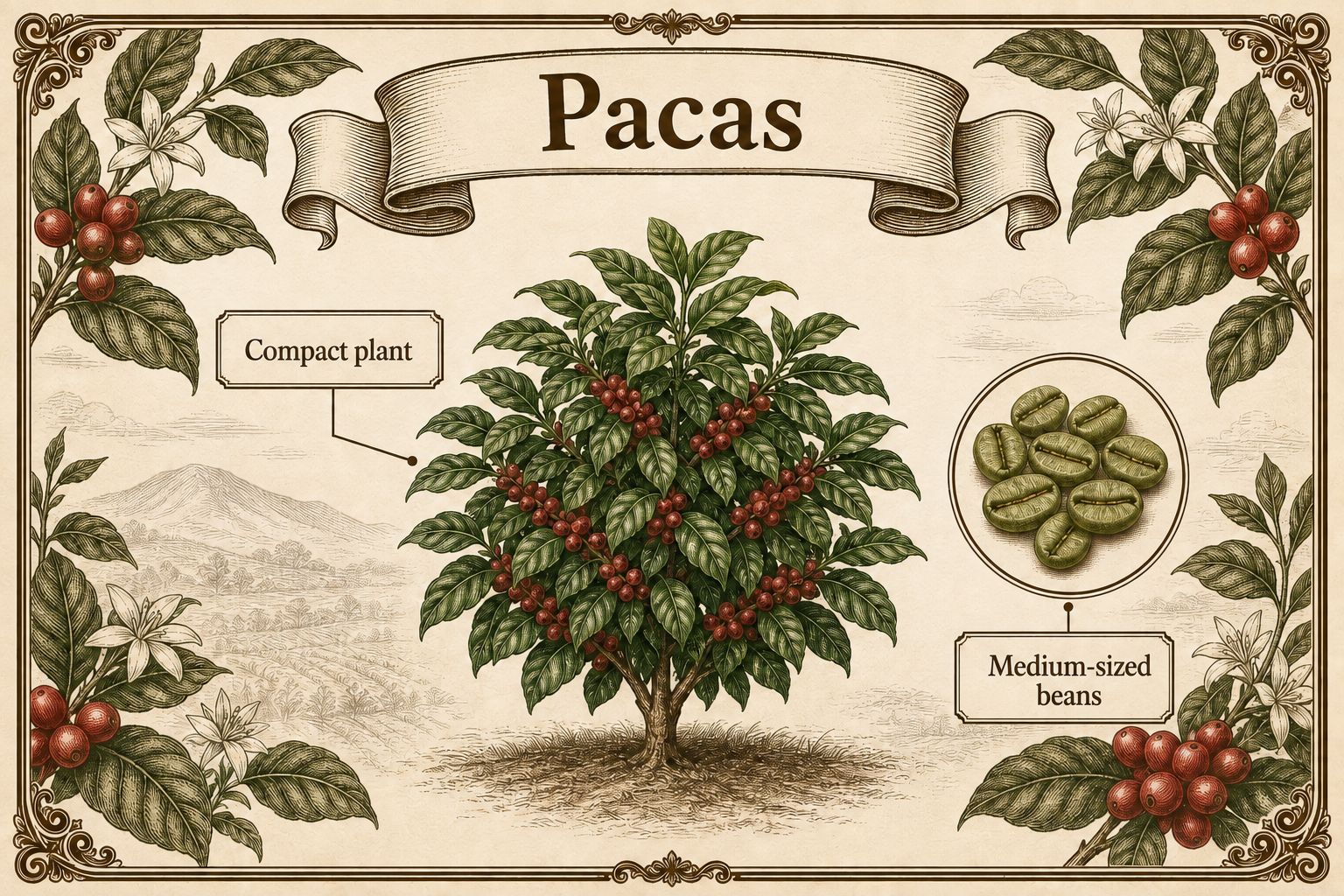
What Is Pacas Coffee—and How Is It Different From Pacamara?
Pacas is a natural dwarf mutation of Bourbon, found in 1949 on a Pacas-family farm in Santa Ana, El Salvador. The plant stays compact and the beans are average in size. World Coffee Research rates high-elevation cup quality as good and flags very high susceptibility to coffee leaf rust. It is a parent of Pacamara.
Updated: Aug 30, 2026Reviewed by: Content and layout review
What Pacas means on a coffee bag
Pacas identifies an arabica variety on a coffee label. To learn where the coffee was grown and how it was processed, check the origin and processing information on the bag.
It is a natural mutation of Bourbon. World Coffee Research traces it to a 1949 discovery on a farm owned by the Pacas family in Santa Ana, El Salvador. The Salvadoran Institute of Coffee Research (Instituto Salvadoreño de Investigaciones del Café, ISIC) began pedigree selection in 1960.
Pacas has compact plants, average-size beans, and medium yield potential, with the first crop in year three. It is susceptible to coffee leaf rust, nematodes, and coffee berry disease. World Coffee Research rates its high-elevation quality potential as good; the catalog summary describes standard Central American quality and emphasizes very high rust susceptibility.
Pacas appears most often in coffees from El Salvador and also from Honduras. It provides information about the plant and its growing characteristics, while flavor depends on the individual lot.
How it differs from Bourbon and Caturra
Pacas is closely related to Bourbon but differs in stature: Bourbon is tall, while a single-gene mutation keeps Pacas compact. World Coffee Research identifies this smaller stature as its main agronomic advantage, allowing denser planting that can increase total fruit production per area. Its listed single-stem planting density is about 5,000 to 6,000 plants per hectare, compared with about 3,000 to 4,000 for Bourbon.
Caturra is another dwarf Bourbon mutation, independently discovered in Brazil around 1915 to 1918. World Coffee Research groups Pacas, Caturra, and Costa Rica’s Villa Sarchi as similar mutations, while recognizing them as separate varieties.
Both Pacas and Bourbon are listed as having average-size beans. Their high-elevation cup quality potential is rated good for Pacas and very good for Bourbon, but these ratings cannot directly establish the quality of individual lots.
The diagram compares tall Bourbon (left) with compact Pacas (right); it cannot identify an individual plant.
How it differs from Pacamara
ISIC developed Pacamara by crossing Pacas with Maragogipe and carrying out pedigree selection that remained incomplete. A Perfect Daily Grind interview notes that the name takes the first four letters of each parent.
Both plants are compact, but Pacas has average-size beans while Pacamara has very large beans and high-elevation quality potential rated exceptional by World Coffee Research. The Pacamara article explains its breeding history and variation in later generations.
The diagram compares average-size Pacas beans (left) with very large Pacamara beans (right). Both plants are compact, and bean size alone cannot identify the variety.
Where Pacas is grown
World Coffee Research still describes Pacas as widely grown in El Salvador, about a quarter of national production, with seed available from Procafe. IHCAFE introduced it to Honduras in 1974.
Pacas’s compact form supports denser planting, but leaf rust remains a major growing risk; World Coffee Research does not classify it as disease-resistant.
Common Misconceptions
Is Pacas the same as Pacamara?
Pacas has average-size beans and is one parent of Pacamara, a Pacas × Maragogipe cross with very large beans. They are distinct varieties.
Is Pacas just another name for Bourbon?
Pacas is a natural Bourbon mutation with a compact growth habit. The two are genetically related but remain distinct varieties.
Is it the same as Caturra?
Both are dwarf mutations of Bourbon. Caturra was discovered in Brazil, while Pacas was discovered independently in El Salvador. They remain distinct varieties.
Does Pacas always taste better?
World Coffee Research rates its high-elevation quality potential as good, but origin, processing, and roasting still affect the flavor of each lot.
Why is the plant short?
A single-gene mutation keeps the plant compact, so farmers can plant more densely. It remains highly susceptible to coffee leaf rust.
World Coffee Research, Pacas: Records Pacas as a single-gene dwarf Bourbon mutation, grouped with Caturra and Villa Sarchi. It was discovered in 1949 on a Pacas-family farm in Santa Ana, El Salvador; ISIC began pedigree selection in 1960, and IHCAFE introduced it to Honduras in 1974. WCR lists about a quarter of Salvadoran production as Pacas. Plants are compact, with average-size beans, medium yield, and first production in year three. The variety is susceptible to coffee leaf rust, nematodes, and coffee berry disease, with high-altitude quality potential rated good. The catalog summary describes standard Central American quality and very high rust susceptibility, and lists single-stem planting density at about 5,000 to 6,000 plants per hectare.
World Coffee Research, Bourbon: Describes tall Bourbon plants with average-size beans, medium yield, first production in year four, and high-altitude quality potential rated very good. Listed single-stem planting density is about 3,000 to 4,000 plants per hectare. Descendants have largely replaced Bourbon in Latin America, though it remains in El Salvador, Guatemala, Honduras, and Peru.
World Coffee Research, Caturra: Records Caturra as a separately discovered dwarf Bourbon mutation from Brazil around 1915 to 1918, similar in mutation type to Pacas but recognized as a distinct variety.
World Coffee Research, Pacamara: Describes Pacamara as a Pacas × Maragogipe cross developed through incomplete pedigree selection by ISIC. Its plants are compact, with very large beans and high-altitude quality potential rated exceptional.
Perfect Daily Grind, Interview: What’s so special about Pacamara?, 2015: Explains how the Pacamara name combines the first four letters of each parent. Tasting comments are personal observations, while the interview's claim about Pacas disease resistance differs from WCR; the disease information here follows WCR.