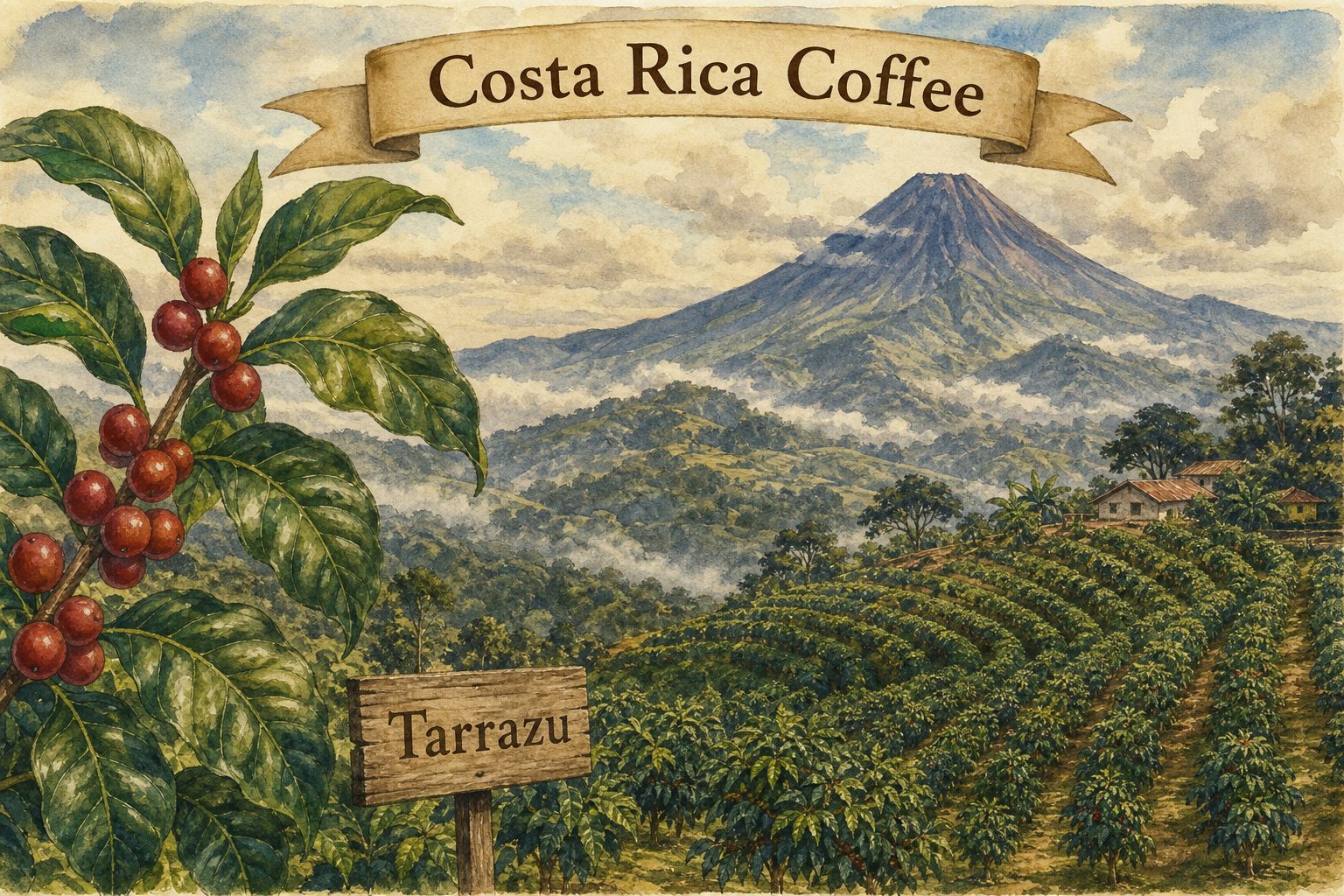
What Does Costa Rican Coffee Taste Like—and What Is Tarrazú?
Costa Rican specialty lots are usually high-grown washed arabica, clean and balanced in the cup. Tarrazú is a region name. SHB is a high-grown hard-bean grade, not a guarantee of a better cup. Honey-processed micro-mill lots are increasingly common.
Updated: Aug 29, 2026Reviewed by: Content and layout review
What a Costa Rica label is telling you
A bag marked Costa Rica often suggests a Central American washed arabica that is clean and balanced, with acidity that is clear rather than sharp. Importers also commonly bring in a colorful range of honey-processed lots.
If the label reads Costa Rica Tarrazú SHB, the country, the region, and the altitude grade are three different claims.
USDA records about 1.16 million 60-kilogram bags for 2025/26, about 0.65% of world production, down from about 1.32 million bags the previous season. The same production series shows an origin that is almost entirely arabica. The Costa Rican Coffee Institute (Instituto del Café de Costa Rica, ICAFE) groups growing areas into eight regions.
Costa Rican single-origin lots are commonly high-grown and washed. Tarrazú identifies a region, while SHB indicates an elevation-related grade. A honey label describes a different drying method from washed processing.
Why the cup is often clean and balanced
The usual impression comes from high elevation and carefully processed washed lots. Compact varieties such as Caturra are widely planted: the cup is usually clearly structured, and the flavors are rarely extreme.
Coffee Review describes the traditional Costa Rica cup as clean, balanced, and complete in structure, with nut, ripe citrus, chocolate, and stone-fruit notes. A good high-grown SHB can be clean and balanced, with a solid finish.
Fields are led by Caturra, with Catuai, Typica, and some Bourbon. Villa Sarchi is a dwarf Bourbon mutation found in Alajuela. World Coffee Research dates that selection to the 1950s or 1960s; the variety later became one parent of the Sarchimor rust-resistant hybrids.
Smallholders traditionally delivered cherries to large mills that combined fruit from many farms. Compact mechanical demucilagers later made smaller mills practical. USDA records an increase from 210 mills in 2013/14 to 308 in 2023/24, many of them micro-mills serving a few nearby farms. Coffee Review credits these mills with developing and naming honey processing, which leaves some mucilage on the parchment during drying. The honey-processing article explains the yellow, red, and black labels.
Eight regions, and Tarrazú
Coffee Review and World Coffee Research list ICAFE’s eight regions: Tarrazú, Central Valley, West Valley, Tres Ríos, Brunca, Turrialba, Guanacaste, and Orosi.
Coffee Review notes that official region names roughly match geography, but variety and process often create bigger flavor differences than the region name does. Micro-mill experiments make a region name an even weaker flavor promise.
Tarrazú, south of San José, has on average the highest farms and the most prestigious name. Central Valley, West Valley, and Tres Ríos sit closer to the capital and remain classic origins. Brunca is the string of districts running southeast toward Panama.
Eight official region names, with Tarrazú shown south of San José. This is a sketch, not a cadastral map.
What SHB is
SHB means Strictly Hard Bean, a high-grown grade associated with denser seeds. Green-coffee trade descriptions often place that line around 1,200 meters. An altitude grade has nothing to do with a cupping score.
A bag can carry all three terms. They answer different questions.
ICAFE was founded in 1933. Daily Coffee News, summarizing USDA’s 2026 annual report, records 24,653 coffee growers in 2024/25, about half the number from a decade earlier.
How Costa Rican coffee often tastes
Common descriptions include a clean structure with nuts, ripe citrus, chocolate, and stone fruit. Carefully processed high-elevation washed lots often express these traits clearly. Honey lots may taste sweeter, while poor drying can produce a rougher cup.
Small lots of Gesha and SL28 are starting to appear at micro-mills. More micro-lots are showing up as well.
If the bag says Costa Rica, start with a high-grown washed arabica and a clean cup. If it also says Tarrazú, you have a region name. If it also says SHB, you have an altitude grade. None of those words guarantees a brighter or more distinctive cup than a neighbor from Guatemala or Honduras.
Common Misconceptions
Is Tarrazú another name for Costa Rica?
No. Tarrazú is one growing region within Costa Rica. A bag labeled only Costa Rica does not establish that the coffee comes from Tarrazú.
Does SHB guarantee better coffee?
No. SHB is a high-grown hard-bean grade. Cup quality still depends on the farm, process, and roast.
Is Costa Rican coffee always washed?
Washed lots are the traditional export path. Honey and natural lots from micro-mills are increasingly common. Read the process on the bag.
Does Costa Rican coffee always taste clean and balanced?
Clean high-grown lots often do. Honey lots may taste sweeter, or rougher if drying goes poorly.
Do the eight regions taste sharply different?
ICAFE names eight regions. The official names roughly match geography, but variety and process often create bigger flavor differences than the region name does. A single farm or micro-mill lot is usually more distinctive than the region name.
Kenneth Davids, Costa Rica Coffee, Coffee Review, excerpted from 21st Century Coffee: A Guide: Describes Costa Rica’s traditional clean, balanced flavor profile and eight ICAFE regions, highlighting Tarrazú for its elevation and reputation. It also discusses the prevalence of Caturra, large mills combining smallholders’ cherries, and the use of honey terminology by micro-mills employing mechanical demucilaging.
Kenneth Davids, Costa Rican Coffees, Coffee Review: Describes high-grown SHB coffees from near San José as common specialty offerings. Good examples have clean, balanced flavors and a substantial finish.