What Does Honduran Coffee Taste Like—and What Is Marcala?
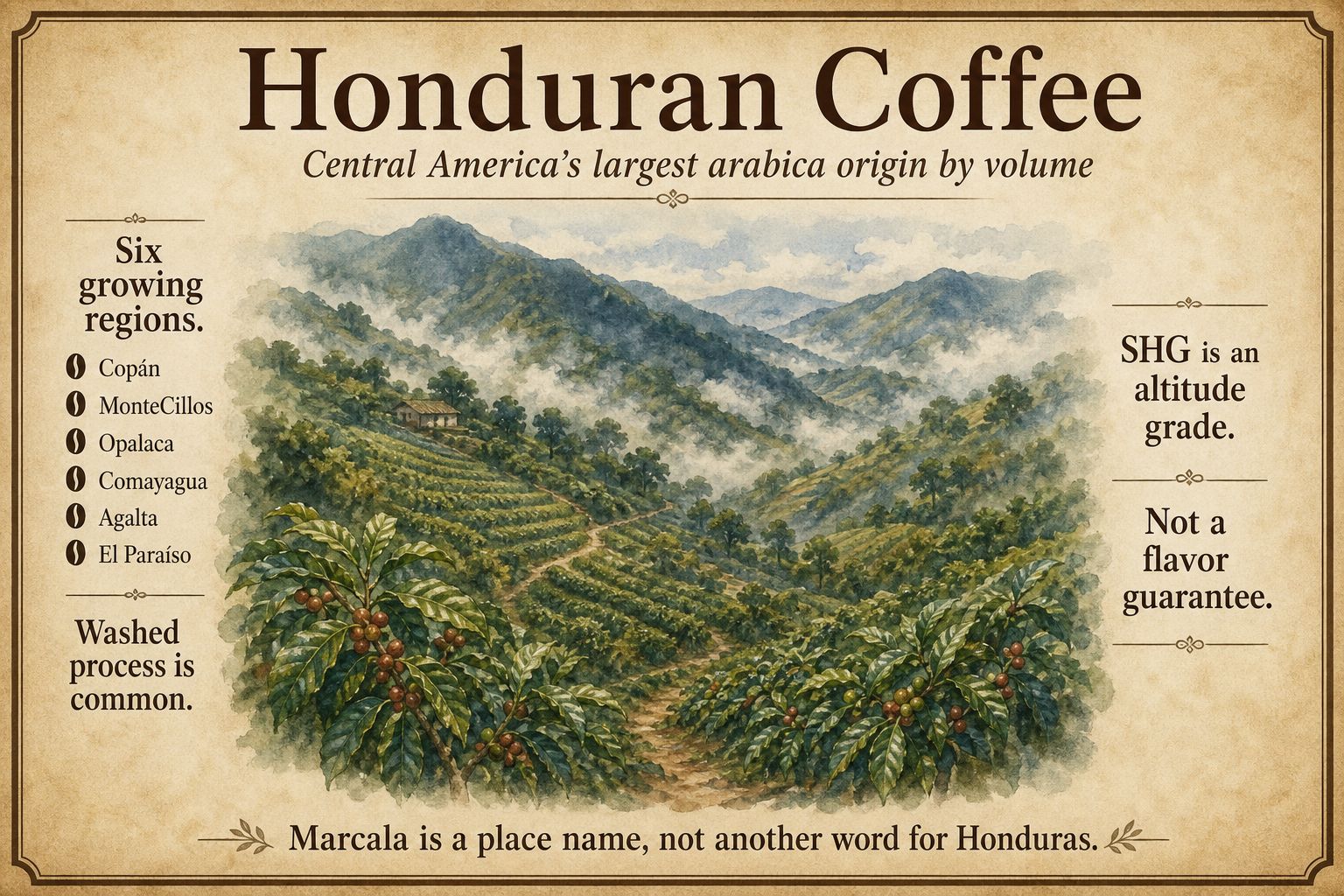
Honduras is Central America's largest arabica origin by volume. Much of what reaches specialty shelves is high-grown and washed, with a balanced, sweetly chocolate-leaning cup. Marcala is a place name and a geographic indication. SHG is an altitude grade, not a guarantee of a better cup.
Updated: Aug 30, 2026Reviewed by: Content and layout review
What a Honduras label is telling you
A bag marked Honduras often suggests a Central American washed arabica with balance, gentle sweetness, and chocolate more prominent than sharp citrus. These are common tendencies rather than guaranteed flavors.
If the label reads Honduras Marcala SHG, the country, the place name, and the altitude grade are three different claims.
USDA forecasts 5.53 million 60-kilogram bags for 2025/26, about 3% of a 178.83-million-bag world crop, up from 5.20 million bags the previous season. The same annual report ranks Honduras as Central America’s largest coffee exporter, third in the Americas, and eighth globally. Production is arabica. The Honduran Coffee Institute (Instituto Hondureño del Café, IHCAFE) groups growing areas into six regions: Copán, Montecillos, Opalaca, Comayagua, El Paraíso, and Agalta.
Honduran single-origin lots are commonly high-grown and washed. Marcala identifies a place, while SHG indicates an altitude grade.
Why the cup is often balanced and chocolate-leaning
Elevation, washed processing, and widely planted compact arabica varieties all contribute to this familiar flavor profile.
Coffee Review calls Honduras a paradox: a large origin that still generates less specialty excitement than Panama or Costa Rica. The best washed lots can be flawlessly clean. Slow drying, common on some small farms, can add molasses, herb, or, when it goes wrong, a murky note.
Cupping notes often describe balanced sweetness and chocolate, with brighter acidity in some high-elevation lots. Floral notes, subtle citrus, caramel, and nuts are also common. A 2013 Coffee Review set of 18 washed Honduras coffees kept returning to clean structure, chocolate, and a crisp aromatic-wood note.
USDA records common Honduran varieties as Bourbon, Catuai, Caturra, and Typica. World Coffee Research records Catuai trials by IHCAFÉ in 1979 and commercial release in 1983, when the variety once approached half of Honduras arabica. Coffee Review finds Bourbon the most distinctive traditional variety, though it usually arrives mixed with Caturra and Catuai. Farmers also grow rust-resistant hybrid cultivars such as Lempira and IHCAFE 90. In 2017, though, a new race of leaf rust overcame Lempira’s resistance.
About 61% of farms sit between 3,900 and 5,200 feet, roughly 1,190 to 1,585 meters. The six regions themselves sit at about 1,000 to 1,600 meters. IHCAFE registered 86,895 small producers for 2024/25, the large majority of growers.
Six regions, and Marcala
USDA and IHCAFE identify six growing regions: Copán, Montecillos, Opalaca, Comayagua, El Paraíso, and Agalta.
Coffee Review notes that similar varieties and washed-processing methods can make broad regional differences less pronounced. Individual farms or cooperative lots often have more distinctive characteristics than the regional label alone suggests.
The highest and most discussed coffees often come from the western mountain spine that borders Guatemala and El Salvador: Copán, Opalaca, and Montecillos. Marcala is a registered appellation of origin from 2005, the first in Central America. Coffee Review places it partly across those western regions.
Honduras joined Cup of Excellence in 2004, opening competition lots to bidding and auction and giving high-quality coffee a chance to stand out.
Six official region names, with Marcala shown in the southwest near El Salvador. This is a sketch, not a cadastral map.
What SHG is
SHG means Strictly High Grown. USDA, citing IHCAFE, also lists HG, large screen size, certified organic, and standard grade among export categories. An altitude grade has nothing to do with a cupping score.
All three terms can appear on one bag, identifying the country, place of origin, and altitude grade.
Leaf rust is still present in Honduras. USDA recorded national average incidence rising from 7.57% to 8.44% in March 2026. Recent growth in planted area is also tied to the rust-resistant cultivar Parainema.
How Honduran coffee often tastes
Common washed-coffee descriptions include balanced sweetness and chocolate, with flowers or subtle citrus more apparent in carefully processed high-elevation lots. Poor drying can produce a rougher cup with molasses or herbal notes.
Small lots of Gesha and Pacamara are starting to appear, and some producers now try natural, honey, or anaerobic methods. More micro-lots are showing up as well.
For a bag labeled Honduras, the balanced flavor of high-elevation washed arabica is a useful starting reference. Marcala provides more specific origin information, while SHG identifies an altitude grade. None of those words guarantees a sweeter, fruitier, or more distinctive cup than a neighbor from Guatemala or Panama.
Common Misconceptions
Is Marcala another name for Honduras?
No. Marcala is a place name and a geographic indication established in 2005. A bag labeled only Honduras does not establish that the coffee comes from Marcala.
Does SHG guarantee better coffee?
No. SHG is an altitude grade. Cup quality still depends on the farm, process, and roast.
Is Honduran coffee always washed?
Washed processing is common in Honduran specialty coffee, though producers also use natural, honey, and anaerobic methods. Check the process listed on the bag.
Does Honduran coffee always taste like chocolate?
Well-processed high-elevation lots often have balanced sweetness and chocolate notes, sometimes with brighter acidity. Poor drying can produce a rougher texture, so the actual flavor varies by lot.
Do the six regions taste sharply different?
Officials brand six regions, but similar varieties and washed processing often blur those lines. Regional differences are often not that large. A single farm lot is usually more distinctive than the region name.
USDA Foreign Agricultural Service, Coffee Annual, Honduras, HO2026-0002, 2026: Reports production of 5.53 million 60-kg bags for 2025/26, compared with 5.20 million in 2024/25 and a forecast of 6.03 million for 2026/27. It also covers export ranking, six growing regions, elevations of 1,000–1,600 m, cultivated varieties, the share of farms between 3,900 and 5,200 feet, coffee production in 15 of 18 departments, and smallholder numbers. Historical milestones include IHCAFE’s founding in 1970, entry into Cup of Excellence in 2004, and the Marcala geographic indication in 2005. The report explains SHG as a high-grown grade and records rust incidence in March 2026 and expansion of the area planted with Parainema.
Kenneth Davids, Honduras Coffee, Coffee Review, excerpted from 21st Century Coffee: A Guide: Discusses the contrast between Honduras’s large production volume and its visibility in specialty coffee. It describes Bourbon grown alongside Caturra and Catuai, rust-resistant hybrid cultivars, washed processing, and quality problems associated with slow drying. It also introduces six named growing regions, the western Copán–Opalaca–Montecillos area, and Marcala’s recognition as Central America’s first appellation of origin in 2005. Tasting observations often describe balanced flavors with chocolate notes.
World Coffee Research, Catuai: Records IHCAFÉ trials in 1979, commercial release in 1983, and a period when Catuai approached half of Honduras arabica.